Table of Contents
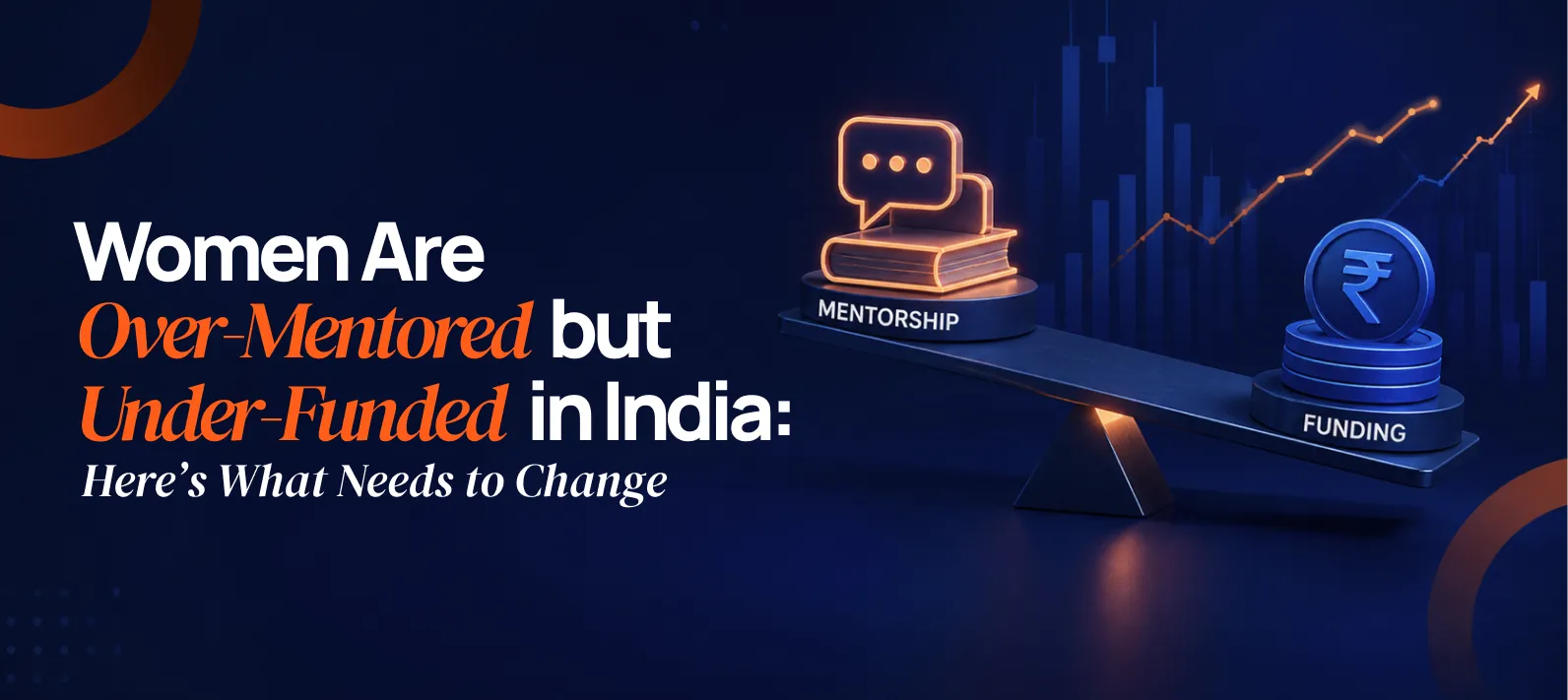
Indian women founders are attending more programs, more panels, and more mentorship cohorts than ever before. But here’s what YourStory SheSparks 2026 made impossible to ignore: women entrepreneurs are being mentored at scale and funded at a trickle. According to Tracxn, women-led startups received less than 5% of total VC deployed in India in 2023, despite representing a growing share of new business registrations. The visibility has improved. The capital hasn’t.
“Over-mentored but under-funded” isn’t just a phrase; it’s a pattern. And it won’t fix itself. This piece looks at why the women funding gap in India persists and what the ecosystem needs to do about it.
Mentorship and funding solve different problems. The ecosystem has been more willing to offer one than the other. Three structural reasons explain why:
Why More Mentorship Hasn't Closed the Gender Gap in VC Funding in India
Networks Drive Deals, Not Programs
Venture funding in India is relationship-driven. Deals happen through warm introductions and investor circles built over the years. Women founders, particularly first-generation entrepreneurs, often enter these rooms later and with fewer prior connections. Mentorship sharpens the pitch. It doesn’t automatically open the door to the room where the check is written.
Bias Shows Up in the Questions, Not Just the Decisions
Harvard Business Review research found that women founders are more likely to face prevention-oriented questions about risk, sustainability, and downside, while male founders get promotion-oriented ones about growth and market opportunity. These aren’t just different conversations. They produce different funding outcomes.
Investment Rooms Lack Diverse Decision-Makers
A 2022 IVCA report found women represent less than 15% of investment professionals at Indian VC firms. When funding decisions are made by homogeneous groups, similar founder profiles get backed repeatedly, not out of malice, but because familiarity drives confidence. Improving women’s leadership in India’s investment sector is a commercial decision as much as a values one.
What Is Working for Women Startup Funding in India
Progress is real, even if uneven. Angel networks like SheCapital and IAN’s women-focused cohorts are providing early-stage capital with mentorship built in. Government schemes SIDBI’s Stand-Up India, Mahila Udyam Nidhi, and the DPIIT Startup India Seed Fund offer non-dilutive capital for founders who don’t want to give up equity at the earliest, most vulnerable stage. And corporate accelerators from Tata, Mahindra, and Godrej are creating credibility signals that help founders raise subsequent rounds. BCG research found that women-founded companies generated 10% more revenue over five years than male-founded counterparts. The performance data is there. The capital allocation needs to follow it.
What Needs to Change: From Awareness to Action
The conversation about female founders’ challenges in India has been had many times. What’s missing isn’t awareness; it’s accountability.
- Investors need to track funding outcomes, not intentions. Sponsoring a women’s entrepreneurship event is not the same as writing a check. Firms serious about closing the gap should publish portfolio diversity data and set targets they’re willing to be held to.
- Mentors need to open doors, not just minds. The most impactful mentors in any founder’s journey are those who made the right introduction at the right time. Advice without access is incomplete.
- Ecosystem builders need to measure what matters. Success should be tracked by capital raised and startup survival rates, not mentorship hours or event attendance.
- VC firms need diverse investment teams. More women in decision-making roles means a wider range of founder profiles get serious evaluation and better capital allocation overall.
What Women Founders Can Do Right Now
Systemic change is necessary and slow. In the meantime:
- Build revenue traction before raising. Strong unit economics reduce the space for bias to operate.
- Seek mentors with active investor relationships. A warm introduction beats a sharper pitch every time.
- Explore grants early. Stand-Up India, Mahila Udyam Nidhi, and DPIIT’s seed fund are underutilized by founders who don’t know they exist.
- Join communities that include investors, not just peers. Warm introduction pathways are built in rooms where capital is present.
The Future of Women's Empowerment in India Won't Be Defined by Mentorship
India’s ecosystem has done meaningful work on visibility. But women’s empowerment in India in the startup context will be measured by one thing: how many women-led companies get the capital they need to scale and win. Mentorship is the foundation. Funding is the building. Women founders aren’t asking for a lower bar. They’re asking for an equal shot at the same one.
If you’re a founder navigating the funding landscape or a mentor who wants to do more than advise, Mr CEO connects you with guidance that moves beyond the room and into the relationship that opens the next door.
FAQs
Why do women entrepreneurs struggle to get funding in India?
Limited investor network access, unconscious bias in funding conversations, a shortage of women decision-makers inside VC firms, and selection criteria that unintentionally filter out first-generation founders all compound each other. No single cause explains it, which is why fixing it requires action across the ecosystem, not just from founders.
What is the over-mentored, under-funded problem for women’s startups in India?
It describes a pattern where women entrepreneurs receive significant mentorship and ecosystem support, but that investment in guidance doesn’t translate into proportional investment in capital. The ecosystem has been more willing to offer advice than funding, and the gap between the two is where many women-led startups stall.
What are the best grants for women entrepreneurs in India?
SIDBI’s Stand-Up India scheme, Mahila Udyam Nidhi through Punjab National Bank, and the DPIIT Startup India Seed Fund are the most accessible government-backed options. Corporate grants from Tata, Mahindra, and Godrej innovation programs are worth exploring for early-stage founders who want non-dilutive capital before approaching institutional investors.
What needs to change for women’s funding in India to improve?
Investors need to publish and be held to portfolio diversity targets. VC firms need more women in decision-making roles. Ecosystem builders need to track funding outcomes rather than participation metrics. And mentors with investor relationships need to use them actively, not selectively.