Table of Contents
- The Numbers: What the Data Actually Shows
- Why Investors Are Being More Selective (The Real Reasons)
- What Investors Are Looking for in 2026 That They Ignored in 2021
- Sectors Still Getting Funded Despite the Slowdown
- What Founders Must Do Differently to Close a Round in 2026
- Mr CEO's Perspective: How to Rise in a Tough Market
- Conclusion
- Frequently Asked Questions: India Startup Funding 2026
If you’re a founder in 2026, you’ve probably asked yourself this:
“Why is it harder to raise money, even when my metrics look better than ever?”
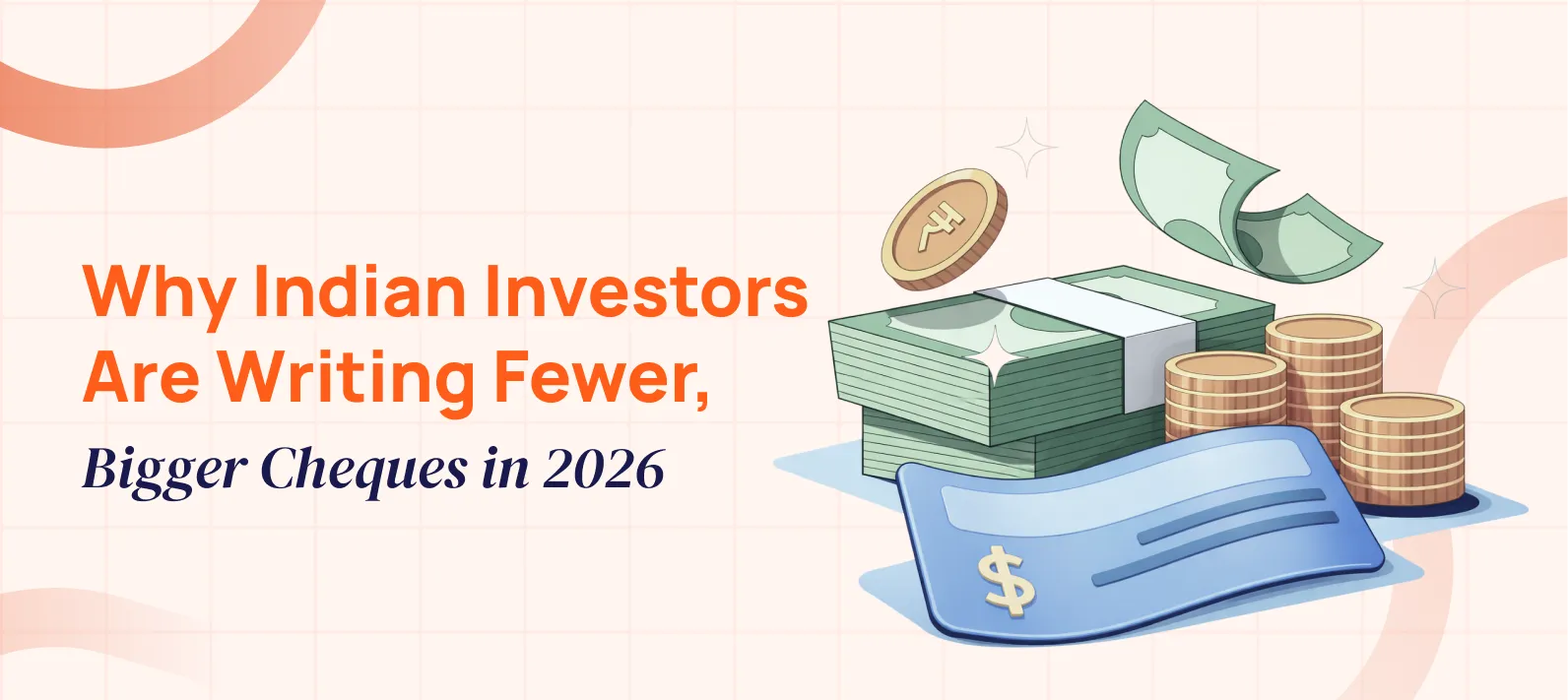
The reality is stark. Indian startup funding is no longer about chasing the next big idea. Now, it’s about backing the few that can actually survive and scale. Investors are writing fewer cheques, but when they do, those cheques are significantly larger.
This shift is reshaping India’s startup ecosystem. Early-stage founders are struggling to get attention, while later-stage startups with proven traction are attracting disproportionate capital.
In this blog, you will understand:
- What the data really says about startup investment in India
- Why VC Investment India is becoming more selective
- Which sectors are still attracting capital
- And most importantly, how to raise startup funding in India in 2026
The Numbers: What the Data Actually Shows
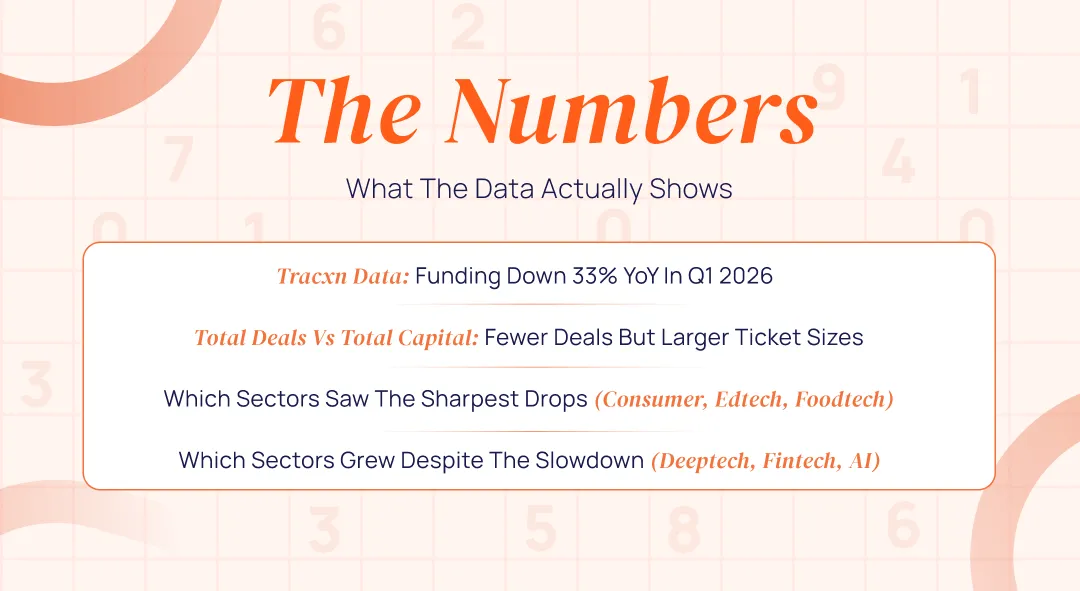
The numbers tell a clear story; this isn’t just perception, it’s a structural shift.
India’s startup funding has moved from a peak-driven market to a discipline-driven ecosystem:
- 2021: ~$42B+ (peak, growth at all costs)
- 2022: ~$25–26B (correction begins)
- 2023: ~$9–11B (funding winter, sharp decline)
- 2024: ~$13–14B (recovery with caution)
- 2025: ~$11–13B (selective capital, focus on profitability)
What changed is not just the amount of money—but how it is being deployed: from chasing hyper-growth to backing startups with strong unit economics and a clear path to profitability.
- Funding dropped ~33% YoY in Q1 2026
- Total deal count declined sharply
- But the average deal size increased
This means fewer startups are getting funded, but those that do are raising larger rounds.
What’s happening beneath the surface?
We are witnessing a ‘Series A Squeeze.’ While Pre-seed remains active for elite founders, the graduation rate to Series A has dropped as VCs now demand EBITDA-positive trajectories rather than just MoM user growth.
Sector-wise breakdown
Sectors that saw sharp declines:
- Consumer startups: Funding activity dropped alongside the broader market, contributing to the overall ~23–26% YoY decline in total capital in Q1 2026, with investors moving away from large consumer bets toward more efficient models
- EdTech: New startup share fell to ~6% of total new incorporations in Q1 2026, indicating reduced investor interest after the pandemic boom
- FoodTech: While still active, funding slowed significantly as part of the overall deal volume drop from ~792 to ~440 deals YoY, impacting discretionary consumer sectors the most
These sectors were overfunded during the 2020–2022 boom and are now facing a correction.
- Sectors still attracting capital:
AI and Agentic AI
FinTech
DeepTech - These sectors continue to see strong investor interest, with AI investments rising ~58% YoY, overall startup funding growing ~23% YoY driven largely by AI-led deeptech, and deeptech funding alone increasing ~37% YoY—clearly indicating where capital is concentrating.
This aligns with a broader shift in venture capital India priorities, from hype-driven to fundamentals-driven investing.
Why Investors Are Being More Selective (The Real Reasons)
This tightening isn’t random—it’s a reaction to multiple systemic changes.
1. The Post-2021 Hangover
The zero-interest-rate era (ZIRP) led to inflated valuations. Many startups raised aggressively without solid fundamentals. Now those rounds are maturing, and reality is catching up.
Investors are correcting past mistakes by tightening entry criteria.
2. Profitability Is the New Growth
In 2021:
- Growth at any cost
In 2026:
- Sustainable growth with clear profitability
Investors now expect startups to show:
- Strong unit economics
- Controlled burn
- Predictable revenue
This has significantly impacted Series A funding in India, where proof matters more than promise.
3. LP Pressure on VCs
VCs don’t operate in isolation. Their capital comes from LPs (Limited Partners), who are now demanding:
- Faster returns
- Real liquidity events
- Better capital allocation
This is pushing VC Investment India toward fewer, high-conviction bets.
4. Global Macro Pressure
Indian startups don’t operate in a vacuum.
- Rising US Fed rates
- Global inflation concerns
- Geopolitical instability
All of these have tightened global liquidity, directly impacting startup funding in India.
What Investors Are Looking for in 2026 That They Ignored in 2021
The evaluation lens has completely changed. Investors are now prioritising profitability, capital efficiency, and sustainable growth over aggressive expansion and vanity metrics.
1. Unit Economics > GMV
Gross Merchandise Value (GMV) used to dominate pitch decks. Now it’s almost irrelevant without profitability.
Investors want:
- Contribution margins
- CAC (Customer Acquisition Cost) vs LTV (Lifetime Value of a customer) clarity
- Payback periods
2. Margin Quality Matters
Revenue alone isn’t impressive anymore.
High-growth startups with poor margins are being rejected, while moderate-growth startups with strong margins are getting funded.
3. Founder-Market Fit Over Pedigree
Earlier:
- IIT/IIM founders had an advantage
Now:
- Deep domain expertise wins
Founder-market fit India investor requirements have evolved. Investors prefer founders who:
- Understand the problem deeply
- Have lived experience
- Can navigate industry-specific challenges
4. Survival Test: Can You Withstand a Funding Winter?
Across India and globally, startups are operating in a far more cautious environment than before—funding is tighter, growth expectations are more realistic, and the pressure to show clear profitability has intensified. Many companies are cutting burn, optimizing costs, and focusing on sustainable growth instead of aggressive expansion.
Investors are asking one core question:
“If funding disappears for 18 months, will this startup survive?”
This has made capital efficiency a top priority in startup investment in India.
Sectors Still Getting Funded Despite the Slowdown
Not all sectors are struggling. Some are thriving.
1. AI and Agentic AI
AI continues to dominate investor interest.
- Over $300M deployed in AI startups in India (2025)
- Focus on automation, enterprise AI, and agent-based systems
This is one of the most promising answers to what sectors are getting funded in India.
2. DeepTech
Includes:
- Defence tech
- Semiconductors
- Robotics
Companies like Ather Energy, Agnikul Cosmos, and ideaForge are strong examples of India’s growing deeptech ecosystem.
These sectors are benefiting from:
- Government support
- Strategic importance
- Long-term global demand
3. B2B SaaS with Global Revenue
India is becoming a global SaaS hub.
Investors love startups that:
- Earn in USD
- Serve international markets
- Have scalable products
This segment remains a strong pillar of India’s startup funding. Companies like Agnikul Cosmos, Bellatrix Aerospace, and Ather Energy are actively attracting capital in this space.
- Agnikul Cosmos has raised around $17 million in funding, reaching a valuation of about $500 million.
- Bellatrix Aerospace recently secured $20 million in a pre-Series B round to scale manufacturing.
- Ather Energy raised about $71 million in a growth-stage funding round.
These examples highlight how deeptech and advanced manufacturing startups are increasingly drawing investor interest, backed by strong use cases and long-term scalability.
4. Climate Tech & AgriTech
Driven by:
- Policy support
- Sustainability mandates
- Large untapped markets
These sectors are increasingly attractive for long-term capital deployment.
What Founders Must Do Differently to Close a Round in 2026
If you’re wondering how to close a funding round in India in 2026, the playbook has changed.
1. Build 18 Months of Runway
Don’t start fundraising when you’re desperate.
Investors prefer founders who:
- Have time to negotiate
- Aren’t under pressure
2. Reduce Burn Before Raising
Cut unnecessary expenses.
A 20% reduction in burn before investor meetings signals:
- Discipline
- Strategic thinking
3. Show Profitability Path
Even if you’re not profitable yet, you must show:
- A clear roadmap
- Realistic timelines (within 24 months)
4. Explore Bridge Rounds
Don’t rely only on VCs.
Look at:
- Angel investors
- Micro-VCs
- Strategic investors
Bridge rounds are becoming critical in fundraising strategy.
Mr CEO's Perspective: How to Rise in a Tough Market
In today’s environment, access matters as much as execution.
1. Mentorship-Backed Founders Win Faster
Mentorship-backed founders fundraising faster in India is becoming a clear trend.
Why?
- Better guidance
- Stronger narratives
- Warmer investor intros
2. Start Building Relationships Early
Don’t wait until you need money.
Start:
- 9–12 months in advance
- Sharing updates
- Building trust
Investors fund founders they’ve tracked over time.
3. Right Investors > More Investors
Spray-and-pray doesn’t work anymore.
You need:
- Sector-aligned investors
- Stage-appropriate funds
- Strategic value addition
4. The Power of Networks
Platforms like Mr CEO help founders:
- Connect with relevant investors
- Refine their pitch
- Navigate Venture Capital India more effectively
In a market where capital is selective, the right network can dramatically improve your odds.
Conclusion
The shift in Indian startup funding isn’t temporary. It’s a reset.
- Fewer deals
- Larger cheques
- Higher expectations
This is forcing founders to build better businesses, not just better pitch decks.
If you adapt to:
- Capital efficiency
- Strong fundamentals
- Strategic fundraising
You won’t just survive this phase—you’ll stand out. Because in 2026, capital isn’t scarce. Conviction is.
Frequently Asked Questions: India Startup Funding 2026
1, Why is it harder to raise Series A funding in India in 2026?
In 2026, the “Series A Squeeze” is driven by a fundamental shift in investor expectations. VCs have moved away from “growth at all costs” and now demand a clear path to profitability (EBITDA-positive). Investors expect to see a repeatable go-to-market motion and strong unit economics rather than just top-line GMV or MoM user growth.
2. Which sectors are receiving the most startup funding in India right now?
AI and Agentic AI continue to dominate the market, attracting nearly 40% of all venture capital in early 2026. Other high-growth sectors include DeepTech (specifically Semiconductors and SpaceTech), FinTech, and Climate Tech. These sectors are favored because they offer high barriers to entry and long-term strategic value.
3. What is the average Series A round size in India for 2026?
While the total number of deals has declined, the average deal size has actually increased. In 2026, a typical Series A round ranges between $10M and $20M. Investors are concentrating their “dry powder” into high-conviction bets, resulting in larger cheques for startups that demonstrate sustainable 15-20% growth.
4. How much runway should a founder have before fundraising in 2026?
Founders should ideally maintain at least 18 months of runway before starting a fundraise. Due to increased selectivity, the due diligence process in 2026 is significantly longer. Having a substantial buffer ensures you aren’t forced into a “down-round” or unfavorable terms out of desperation.
5. Are investors still funding consumer and EdTech startups in 2026?
Funding for traditional consumer and EdTech startups has seen a sharp correction, dropping approximately 25% YoY. However, investors are still backing D2C brands that show exceptional customer retention metrics and EdTech models that integrate AI to solve specific learning outcomes efficiently rather than just scaling content.