Table of Contents
- MAARG vs Private Mentorship: Fast Takeaways
- What Is the MAARG Portal and Who Is It For?
- What Private Mentorship Platforms Offer That MAARG Cannot
- The Tier-2 Advantage: Why Location Is No Longer a Disadvantage
- The Strategic Approach: How to Use Both Networks
- Five Questions to Ask Before Choosing Your Mentorship Path
- Conclusion: The Right Mentor at the Right Stage Changes Everything
- Frequently Asked Questions (FAQs)
You built something real. You have traction, a clear problem you’re solving, and the hunger to scale. But somewhere between where you are and where you want to be, there’s a gap, and you can feel it every time a decision stalls or a strategy doesn’t quite land.
That gap is usually a mentor gap.
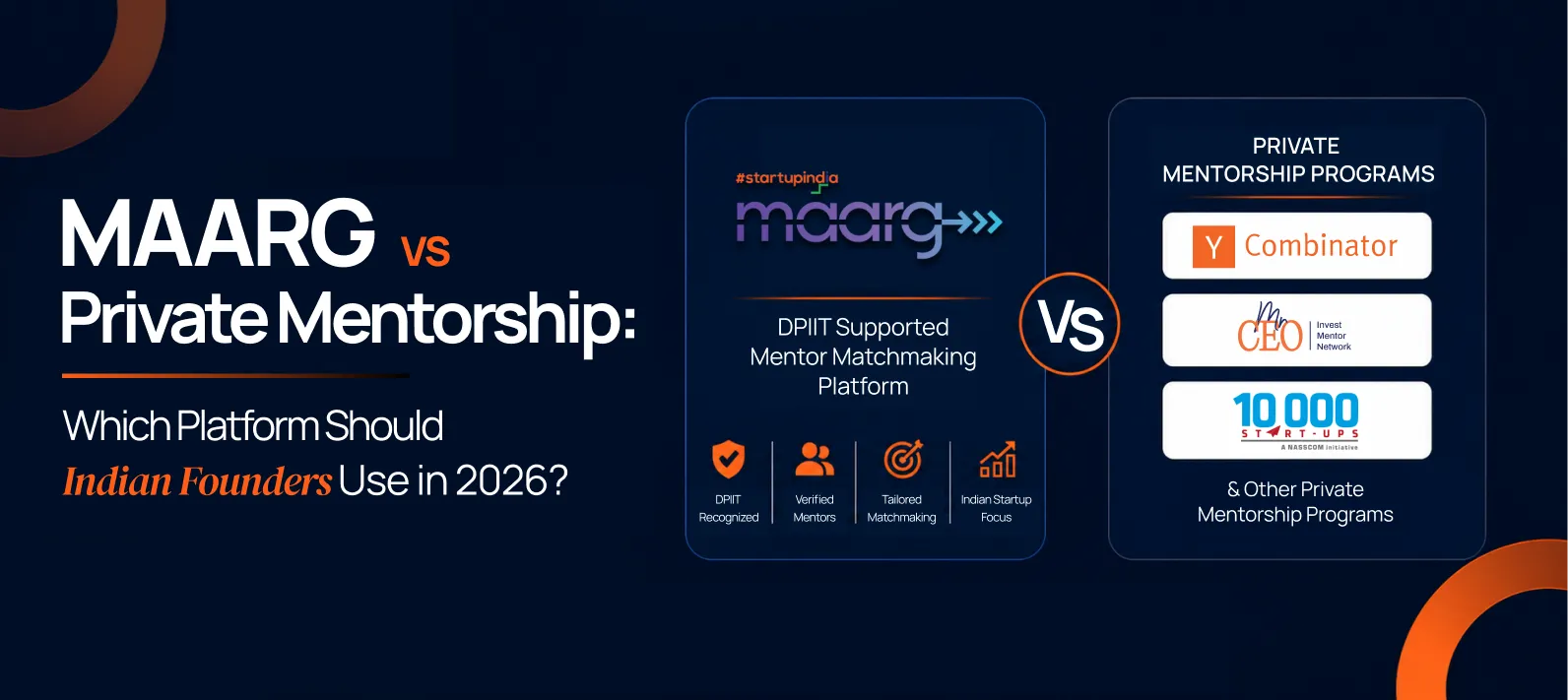
Indian founders have more mentorship options than ever. The MAARG portal, launched by DPIIT under the Startup India initiative, has connected thousands of startups, particularly in Tier-2 and Tier-3 cities, with experienced mentors at zero cost. On the other side, private mentorship platforms offer deeper, more personalized engagement for founders who need more than direction. So which one do you actually need? Let’s be direct about it.
MAARG vs Private Mentorship: Fast Takeaways
| Scaling Metric | Startup India MAARG Portal | Private Mentorship Platforms |
|---|---|---|
| Primary Focus | Ecosystem exposure, regulatory support, and broad business advisory. | Revenue scaling, GTM execution frameworks, and active fundraising strategy. |
| Cost Structure | 100% Free (Requires official DPIIT Recognition). | Premium arrangements via equity-sharing, retainers, or milestone-based structures. |
| Matching Precision | Broad industry-level alignment across a massive pool of 900+ registered ecosystem mentors. | Hyper-specific pairing tailored directly by growth stage, revenue model, and operational niche. |
| Accountability Level | Self-driven ecosystem tracking relying on periodic, founder-initiated check-ins. | High-frequency, structured milestones backed by rigorous execution and performance tracking. |
| Geographic Edge | Massive democratized reach optimizing growth across emerging Tier-2 and Tier-3 cities. | Deep tier-1 metro investor networks natively integrated with expanding regional startup cohorts. |
What Is the MAARG Portal and Who Is It For?
MAARG (Mentorship, Advisory, Assistance, Resilience, and Growth) is a free, government-backed mentorship platform designed for DPIIT-recognized early-stage startups in India to help them navigate the startup ecosystem.
Launched by the DPIIT under the Startup India initiative, MAARG connects recognized startups with over 900 mentors across industries. It’s completely free to access, well-structured, and part of a broader Startup India ecosystem that includes crucial funding schemes, regulatory support, and national networking events.
To utilize MAARG, your startup must be registered and recognized under Startup India. The onboarding process is direct: secure your DPIIT recognition, build out your official startup profile, and submit your core mentorship preferences through the centralized system. Once the platform coordinates a match, you instantly unlock access to ecosystem mentors, specialized learning repositories, and state-backed networking sessions.
MAARG is particularly valuable if you are:
First-Time Founders
Perfect for operators who are starting entirely from scratch and need to build out an initial, credible industry network.
Perfect for operators who are starting entirely from scratch and need to build out an initial, credible industry network.
Early-Stage Operations
Tailored for businesses needing broad macro ecosystem placement and structural exposure rather than hyper-granular niche tactical playbooks.
Tailored for businesses needing broad macro ecosystem placement and structural exposure rather than hyper-granular niche tactical playbooks.
Tier-2 & Tier-3 Hubs
Meaningfully expands access limits for regional innovators scaling outside traditional tier-1 metros like Bengaluru or Mumbai.
Meaningfully expands access limits for regional innovators scaling outside traditional tier-1 metros like Bengaluru or Mumbai.
Government Policy & Grant Access
Ideal for navigating state-backed financial aid paths, seed fund schemes, or participating in key regulatory showcases.
Ideal for navigating state-backed financial aid paths, seed fund schemes, or participating in key regulatory showcases.
⚠️ Where the MAARG Portal Falls Short
MAARG’s greatest strength—its structural scale—inevitably acts as its primary bottleneck. When a national platform serves over 100,000 DPIIT-recognized startups, individual personalization becomes incredibly difficult to deliver.
Because tier-1 ecosystem mentors remain under massive global demand, immediate or precise alignment isn’t always guaranteed. Ultimately, the portal provides strategic direction; it cannot physically sit in the room with your executive team to debug a stalled enterprise sales pipeline or actively refine your presentation mechanics ahead of a high-stakes Series A round.
This isn’t a design flaw—it’s the operational reality of managing a public program at nationwide scale. The fastest-growing companies treat MAARG as an excellent secondary ecosystem resource rather than their core operational execution partner.
What Private Mentorship Platforms Offer That MAARG Cannot
Private mentorship platforms are premium, outcome-driven acceleration services designed for growth-stage founders who require hyper-personalized execution support, daily accountability, and direct investor introductions to scale revenue.
Private mentorship platforms operate from a completely different premise: you don’t just need access to an expert; you need someone invested in your specific outcome. In our exploration of real startup scaling patterns, we find that general advice consistently falls flat when applied to complex operational friction blocks.
The Difference Shows Up in 4 Concrete Ways:
01
Mentor Matching That Goes Deeper
Private platforms match you not just by industry but also by growth stage, revenue model, and the specific challenge you’re trying to solve. A mentor who scaled a D2C brand in Pune brings something completely different to the table than a generalist advisor.
02
Accountability That Moves You Forward
The most underrated element of good mentorship isn’t the advice; it’s the follow-through. Private mentorship programs typically include structured check-ins, milestone tracking, and real accountability. That consistent pressure is what converts strategy into execution.
03
Execution Support, Not Just Direction
Private mentors often help founders work through go-to-market (GTM) strategy, fundraising preparation, team decisions, and revenue planning in real time, not in a scheduled quarterly session. For founders at a critical inflection point, that responsiveness matters enormously.
04
Network Access With Intent
A warm introduction to the right investor or strategic partner can do more in a week than months of cold outreach. Private mentorship platforms, by nature of their mentor relationships, often open doors that government platforms aren’t structured to open.
Stop Collecting Advice. Start Executing With Alpha.
If you need more than simple high-level direction, unlock structured 1-on-1 operational support and direct access to active investor pipelines tailored to your niche.
The Tier-2 Advantage: Why Location Is No Longer a Disadvantage
Here’s something most mentorship conversations miss: the next significant wave of Indian startups isn’t coming solely from Bengaluru or Mumbai. Founders in Indore, Coimbatore, Jaipur, Nagpur, and Surat are solving real, local problems with scale potential, and they’re doing it with less noise and more focus than their metro counterparts.
The MAARG portal has done meaningful work in improving ecosystem access for these founders. But access to a static mentor list is vastly different from access to an active advisor who truly understands the hyper-local dynamics of building in a Tier-2 market: the strict capital constraints, the unique talent realities, and distinct regional customer behaviors.
Private mentorship that’s intentionally focused on these emerging hubs fills that execution gap. Not because Tier-2 founders need a completely different operational playbook—they don’t—but because local context matters deeply when strategic advice moves from theory to real-world action.
Ecosystem NoteWhether you are running operations in major enterprise setups or expanding early footprints through localized network nodes like Mr CEO Nellore, managing micro-market context is what separates fleeting traction from long-term sustainable scale.
The Strategic Approach: How to Use Both Networks
This isn’t an either-or decision. The founders who grow fastest aren’t choosing between MAARG and private mentorship; they’re strategically deploying each platform for what it does best.
Use the MAARG Portal for:
- Startup India Exposure: Direct integration with national network matrices and government-backed grant programs.
- Early-Stage Foundation: Maximizing entry points into state-led incubators and major industry events.
- Macro Guidance: Finding basic structural footing while working toward early product-market fit.
Use private mentorship for the following:
- Revenue Performance: Constructing hyper-targeted growth strategies and market scaling validation.
- Fundraising Alpha: Direct pitch deck scrubbing and warm, intention-driven investor introductions.
- Tactical Execution: Solving hard operational hurdles with veteran builders who have deployed capital before.
- High-Stakes Tracking: Enforcing strict daily accountability loops through intense inflection phases.
By establishing your baseline infrastructure via public programs, you position your brand to extract maximum alpha when transitioning into dedicated growth acceleration systems.
Five Questions to Ask Before Choosing Your Mentorship Path
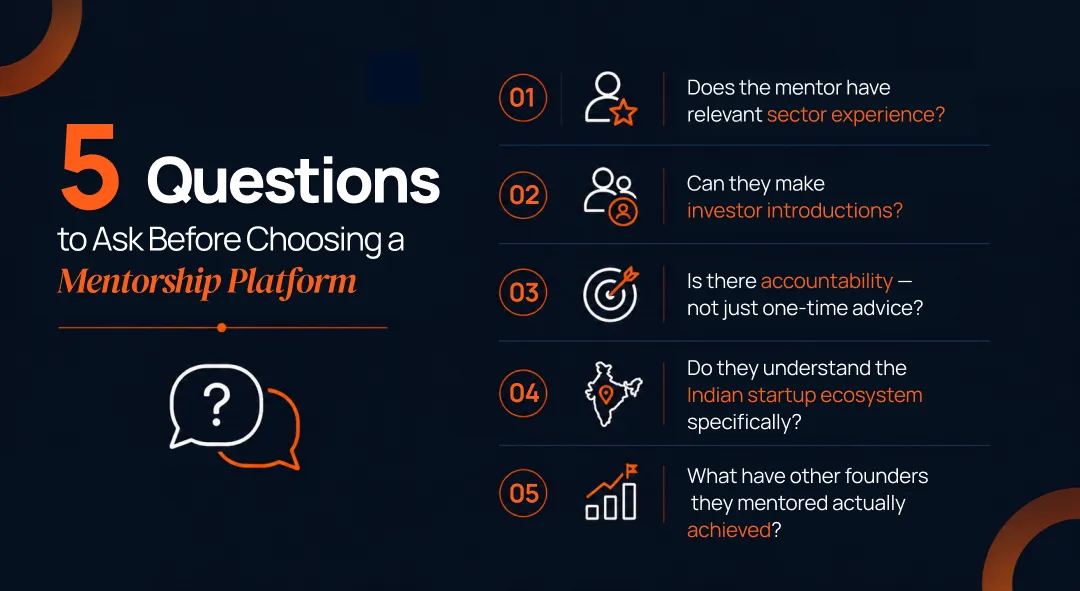
Before signing up for any platform or cohort, be completely honest with yourself about what your startup actually needs to crack the next growth level right now:
1
Do I need broad advice or deep execution support?
If your operational bottleneck is simply knowing what to do, broad programmatic mentorship works. If your strategic bottleneck is actively doing it, you need an operator who is heavily invested in your operational outcome.
2
How stage-specific is my current scaling challenge?
A founder raising an early seed round needs completely different guidance frameworks than an enterprise builder structuring a core management team. Niche matching by growth stage dictates advice clarity.
3
Do I need ecosystem access or performance accountability?
Public portals like MAARG serve as phenomenal tools for opening initial doors into the startup registry ecosystem. Private configurations exist to keep you moving through those open doors under structured performance loops.
4
What is my operational timeline for solving this friction block?
If you are sitting at an immediate strategic inflection point that cannot wait for quarterly programmatic review schedules, the rapid responsiveness of real-time private coaching networks becomes an indispensable variable.
5
Am I looking for high-level generalists or deep unit-economic operators?
General advisors give excellent macro-level feedback on market potential. However, if your business is dealing with local supply realities, capital constraints, or GTM unit economics, you require peer-level matching with active founders who have personally managed a balance sheet in your exact market.
Conclusion: The Right Mentor at the Right Stage Changes Everything
There’s no universal answer to whether MAARG or private mentorship is better because the right answer depends entirely on where you are and what you need to move forward.
What’s clear is this: access to mentorship has never been the real barrier for Indian founders. The barrier is finding a mentor who understands your context, engages with your actual challenges, and stays in it with you long enough to see results.
MAARG gives you the ecosystem. The right private mentor gives you the edge.
If you’re a founder, especially one building in a Tier-2 city where the opportunities are real but dedicated guidance is harder to find, Mr CEO offers premium, results-driven one-on-one and group mentorship. Led by experienced ecosystem operators who have built real businesses, our programs are designed to meet you exactly where you are and push your execution further than you’d ever get alone.
Ready to Scale Beyond Strategic Bottlenecks?
Join targeted regional cohorts across our hubs in Bangalore or Hyderabad or our expanding Tier-2 network nodes.
Frequently Asked Questions (FAQs)
Q1. Is the MAARG portal free to use?
Yes. MAARG is a government-backed platform under the Startup India initiative, so there is zero cost to access its mentors or learning resources. You only need to secure official DPIIT recognition to get started.
Q2. Can I use MAARG if my startup is in a Tier-2 or Tier-3 city?
Absolutely—and you should. MAARG was designed with regional accessibility in mind. Founders outside major metros find it genuinely useful for ecosystem exposure and early-stage guidance. The gap typically shows up later, when you require context-specific execution advice for your local market rather than general direction.
Q3. What is the main difference between MAARG mentorship and private mentorship?
The difference comes down to scale versus depth. MAARG gives you broad access to a massive pool of mentors within a government ecosystem framework. Private mentorship gives you a smaller, hyper-focused relationship where your mentor tracks your weekly progress, pushes back on your operational decisions, and is directly invested in a specific growth outcome.
Q4. Do I need to choose between MAARG and private mentorship?
No, and most hyper-growth founders don’t. The smartest strategy is to use MAARG for broad ecosystem access, government schemes, and early-stage networking, while simultaneously leveraging private mentorship when you hit a growth stage where generalized advice is no longer enough to solve hard operational calls. Learn more about balancing your scaling approaches on our founder strategy portal.
Q5. At what stage should I consider private mentorship for my startup?
You should consider private mentorship when your startup is past basic validation and the decisions you are making on fundraising, team building, GTM execution, or revenue models carry major consequences. That is when a dedicated mentor who knows your business specifically—not just your industry generally—delivers a clear return on investment.