Table of Contents
- The Death of Growth at All Costs in Indian Startups
- Understanding Unit Economics: A Plain Language Guide for Founders
- Real Examples, Indian Startups That Got Profitable Without Sacrificing Growth
- The Profitability Metrics Investors Now Check at Every Stage
- How Mentorship Helps Founders Build Profitable Businesses Faster
- How Terralogic Can Help You Build for Profitability
- Conclusion
- Frequently Asked Questions (FAQs)
For years, Indian founders chased one number: growth. Now the question has changed. “Is your startup actually making money, or just burning it faster?”
This shift marks the transition towards the ‘Fundamental Summer’ of 2026, a new era of Indian startups’ profitability. Investors are no longer impressed by vanity metrics. They are asking tougher questions about sustainability, margins, and long-term value creation.
The reality is simple. The companies that survive this cycle will not be the fastest-growing. They will be the most disciplined.
In this blog, you will learn:
-
Why the shift from growth to unit economics in India is happening
-
The metrics that actually matter in Indian startup funding
-
Real examples of profitable startups
-
How to build a business where startup profitability is not an afterthought
The Death of Growth at All Costs in Indian Startups
Between 2021 and 2024, capital was easy. Startups scaled aggressively, often without a clear path to profits. But the correction was inevitable.
What went wrong
Several high-profile startups saw valuation cuts and investor pushback.
-
BYJU’S faced intense scrutiny over financials and cash burn
-
Ola struggled with profitability challenges across segments
-
Paytm saw a market correction post listing
These examples reshaped how investors evaluate startup growth vs. profitability.
Why investors now penalise high burn
Today, a high burn rate startup in India signals risk, not ambition. Investors now believe:
-
Growth without margins is fragile
-
Cash-heavy models collapse in downturns
-
Profitability is the ultimate validation
Default alive vs default dead
This framework is now widely used by founders and investors.
-
Default alive means your startup can survive without new funding
-
Default-dead means you rely on constant capital infusion
In 2026, the ‘Series B Wall’ has become a filter: if you aren’t ‘Default Alive’ by your second major round, the capital markets are effectively closed to you.
Understanding Unit Economics: A Plain Language Guide for Founders
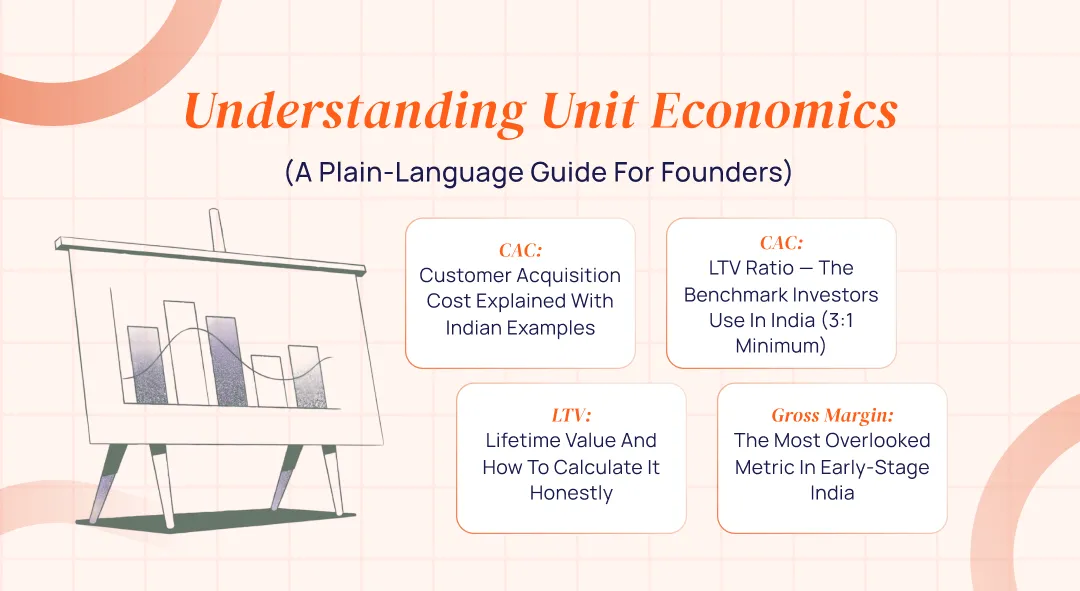
To win in today’s environment, founders must deeply understand unit economics in India, which simply means the revenue and costs associated with each individual unit of your business (like one customer or one order), and whether that unit is profitable or not.
CAC: Customer Acquisition Cost
CAC is the cost to acquire one customer. It includes:
- Ads
- Sales team
- Marketing tools
If you are wondering how to calculate customer acquisition cost in India, the formula is simple:
CAC Formula:
Total Marketing and Sales Spend ÷ Number of New Customers Acquired
When calculating CAC, founders must include fully-loaded costs, including payment gateway fees and last-mile logistics, which are often hidden in ‘Growth’ budgets.
Example:
Let’s say a startup spends ₹5,00,000 on marketing and sales in one month, and in that same month, they acquire 1,000 new customers.
- Calculation: CAC = 5,00,000 ÷ 1,000 = ₹500
- Meaning: The company spends ₹500 to acquire one customer.
LTV: Lifetime Value
LTV is the total revenue a customer generates over their lifetime. A realistic LTV considers:
- Repeat purchases
- Retention rate
- Margins
Example:
Imagine you run an online clothing store.
- Average order value = ₹1,000
- A customer buys 3 times a year
- On average, they stay with your brand for 2 years
LTV Formula & Calculation:
LTV = Average Order Value × Annual Purchase Frequency × Customer Lifespan (Years)
LTV = 1,000 × 3 × 2 = ₹6,000
This means one customer generates ₹6,000 in total revenue during their lifetime with your business.
Why this matters: If your CAC (from earlier) is ₹500 and your LTV is ₹6,000, you’re in a strong position — you’re earning much more from a customer than what you spend to acquire them.
If you want, I can also break this down for startups like Zepto or Mamaearth to make it more real-world.
CAC:LTV Ratio
CAC:LTV Ratio compares how much you spend to acquire a customer (CAC) versus how much revenue that customer generates over time (LTV). It helps measure business efficiency — whether you’re spending wisely to gain customers.
A healthy benchmark is around 1:3 (for every ₹1 spent, you earn ₹3). The CAC LTV ratio startup benchmark is critical.
- The ideal ratio is 3:1 or higher
- A lower ratio means weak profitability
This is one of the best unit economics metrics for startups. While 3:1 is the baseline, 2026 VCs are looking for a 6:1 LTV:CAC ratio in SaaS and a CAC Payback Period of under 6 months for D2C/B2C.
Gross Margin
Often ignored, but extremely important. Gross margin tells you how much profit do you make after direct costs.
In India, many startups fail because they ignore margin quality early on. This directly answers why Indian startups fail at unit economics. Beyond Gross Margin, you must track Contribution Margin 3 (CM3)—which accounts for fixed costs and corporate overhead—to prove the business can actually sustain itself.
Real Examples, Indian Startups That Got Profitable Without Sacrificing Growth
Let’s look at companies that cracked the balance between scale and Indian startups’ profitability.
Zepto – Cracking the Quick Commerce Profit Puzzle
Many founders ask, “How does Zepto make money?”
Zepto operates on a dark store model, where small, strategically located warehouses enable ultra-fast deliveries. This setup reduces last-mile costs and improves operational efficiency. It allows:
-
Faster delivery: 10–15 mins boosts customer stickiness
-
Better inventory control: Less wastage, optimized stocking
-
Higher order frequency: Repeat purchases driven by convenience
Its path to profitability lies in increasing order density per store and improving margins through private labels and better sourcing.
Mamaearth – From D2C Burn to Omnichannel Profitability
A common query is how Mamaearth became profitable.
Initially, Mamaearth relied heavily on digital ads for customer acquisition, which kept CAC high. Over time, it expanded into an omnichannel strategy—offline retail, marketplaces, and its own website. This shift helped:
-
Reduce CAC: Less dependency on paid ads
-
Increase repeat purchases: Better brand visibility offline
-
Improve margins: Diversified revenue streams
The brand also leveraged strong storytelling and influencer marketing to build trust and long-term customer loyalty.
Zoho – Profitability as a Philosophy, Not a Phase
Zoho is often seen as the gold standard of profitability. Unlike many startups, Zoho was bootstrapped from day one, avoiding external funding pressures. It focused on:
-
Sustainable, steady growth instead of aggressive scaling
-
Building a comprehensive product ecosystem (CRM, finance, HR tools)
-
Expanding globally while keeping costs controlled
Zoho proves that profitability is a cultural mindset—driven by discipline, long-term thinking, and independence—not just a financial milestone.
What these companies did differently
-
Focused on margins early
-
Controlled burn
-
Built strong retention
-
Avoided vanity metrics
The Profitability Metrics Investors Now Check at Every Stage
If you are raising capital, your focus should evolve as your business matures. To satisfy modern search algorithms and give you a scannable structural blueprint, here is how the funding milestone expectations break down across key financial indicators in the current 2026 funding ecosystem:
| Funding Stage | Core Operational Focus | Critical Metrics Required | Baseline Benchmarks (2026 Market) |
|---|---|---|---|
| Pre-seed | Proving the Foundation | Gross Margin, Early Retention | Gross Margin > 50% |
| Seed | Showing Early Efficiency | CAC Payback Period, LTV:CAC | Payback < 12 Months; LTV:CAC 3:1 |
| Series A | Scaling with Structure | Revenue Consistency, Contribution Margin | Visible path to positive EBITDA (CM3) |
| Series B+ | Proving Profitability | Free Cash Flow, Operational Excellence | Positive FCF Quarters |
Pre-seed – Proving the Foundation
“I want to raise a pre-seed round—what should I focus on?”
At this stage, investors are betting on your idea and early validation. You should show:
- Gross margin above 50% (indicates the business can be viable long-term)
- Early signs of retention (users are coming back, not just trying once)
The goal here is simple: prove that your product solves a real problem and has the potential to make money.
Seed – Showing Early Efficiency
“It’s been a year, now I want to raise a Seed round—what matters most?”
Now investors expect early traction with discipline. Focus on:
- CAC payback period under 12 months (you recover acquisition cost quickly)
- Improving CAC:LTV ratio (your unit economics are getting stronger)
This stage is about showing that growth is not random—you can acquire and retain customers efficiently.
Series A – Scaling with Structure
“I’m preparing for Series A—what should I optimise?”
At this point, investors want clarity on scale and a path to profitability. You need:
- Clear revenue growth and consistency
- A visible path toward positive EBITDA
The shift here is from experimentation to building a repeatable, scalable business model.
Series B and Beyond – Proving Profitability
“Now I’m scaling further—what do investors expect?”
Here, the focus is on financial strength and operational excellence:
- Free cash flow positive quarters
- Strong operational efficiency across teams
In essence, you move from “Does this idea work?” → “Can this grow efficiently?” → “Can this scale profitably?” → “Can this sustain long-term value?”
How Mentorship Helps Founders Build Profitable Businesses Faster
Building a profitable startup is not just about numbers. It is about decision-making.
For example, Airbnb struggled in its early days with low bookings and unclear positioning. Mentors at Y Combinator pushed the founders to focus on user experience and trust, even suggesting they personally improve listing photos. This small but sharp decision significantly increased conversions and set the company on a path to scalable growth.
Similarly, Dropbox refined its go-to-market strategy with mentorship, shifting from heavy ad spending to a referral-driven growth model. This reduced CAC dramatically while increasing user acquisition, helping the company grow efficiently without burning excessive capital.
These examples show how the right guidance can turn scattered efforts into focused, high-impact decisions that directly improve profitability.
Mentors identify blind spots
Many founders struggle with:
-
Incorrect CAC calculations
-
Overestimated LTV
-
Hidden costs
Mentors catch these early, before investors do.
Faster learning curve
Instead of trial and error, founders can:
-
Learn proven frameworks
-
Avoid costly mistakes
Terralogic’s “Mr. CEO” Approach
This is where structured mentorship and experience-driven guidance come into play, helping founders make sharper decisions that directly impact profitability and long-term growth. Through specialized programs like Mr. CEO—Terralogic’s dedicated executive mentoring ecosystem—we bridge the gap between technical scale and financial discipline.
The Mr. CEO framework focuses on:
-
Strong unit economics
-
Long-term sustainability
This is why mentorship-backed founders fundraising faster in India is becoming a real trend. By pairing deep data architecture with operational expertise, leaders learn exactly how to configure dashboards that track hidden corporate leakages before they hurt valuation.
How Terralogic Can Help You Build for Profitability
Shifting your framework from unbridled growth to tight unit economics requires accurate data infrastructure, advanced tracking dashboards, and robust cloud scaling. At Terralogic, we specialize in providing startups with the custom digital engineering, automated data pipeline integrations, and predictive analytics platforms needed to isolate true performance indicators like CM3 and fully loaded CAC in real time.
Whether you need to reconstruct your data schema to trace last-mile delivery leakages or integrate intelligent analytics to measure real user retention metrics, our engineering teams provide the operational runway to transition your brand from default dead to default alive.
Conclusion
The era of reckless growth is over. The future belongs to startups that understand unit economics in India, control their burn rate in India, and build with discipline.
So if you are still asking, “Startup profitability vs. growth: which is better in India?” the answer is clear. Profitability is not the opposite of growth. It is the foundation of sustainable growth. And in 2026, that is exactly what investors are backing.
Frequently Asked Questions (FAQs)
1. What is a good LTV:CAC ratio benchmark for Indian startups in 2026?
While a 3:1 ratio (earning ₹3 for every ₹1 spent on acquisition) remains the traditional baseline for stability, the 2026 venture capital landscape demands higher efficiency. Investors now target a 6:1 LTV:CAC ratio for B2B SaaS companies and require a Customer Acquisition Cost (CAC) Payback Period of less than 6 months for D2C and B2C brands due to higher consumer price sensitivity and market churn.
2. Why do many Indian startups fail at unit economics?
Most Indian startups fail at unit economics because they map growth using vanity metrics while overlooking fully-loaded, hidden variables. In the Indian ecosystem, factors like high Cash-on-Delivery (COD) return rates (which can hit 20% to 30% in D2C), payment gateway processing fees, steep discounting structures, and localized last-mile logistics overhead are frequently misclassified as corporate expenses instead of direct unit costs.
3. What is the difference between “Default Alive” and “Default Dead”?
A startup is considered Default Alive if its existing growth rate and current cash reserves allow it to reach self-sustaining profitability before running out of funds, without needing external capital injections. Conversely, a startup is Default Dead if it relies on a continuous loop of venture capital infusion to survive, meaning it will collapse the moment market funding slows down or stops.
4. How does Contribution Margin 3 (CM3) differ from standard Gross Margin?
Gross Margin only tracks revenue minus the direct Cost of Goods Sold (COGS). Contribution Margin 3 (CM3) digs much deeper by subtracting all variable operating costs—including payment gateway integrations, variable marketing burn, packaging, and shipping costs—alongside localized fixed overhead allocations. Tracking CM3 proves to investors whether your business can scale its core transactions while supporting corporate architecture.
5. Why are investors prioritizing unit economics over aggressive scaling in India right now?
Following intense market corrections and high-profile valuation rollbacks between 2021 and 2024 (such as with BYJU’S, Ola, and Paytm), capital markets transitioned into a period of extreme valuation discipline. Investors now penalize high-burn operational structures because growth achieved without sustainable underlying margins is inherently fragile. Strong unit economics serve as the ultimate operational validation for a business model’s long-term endurance.
Stop Guessing Your Unit Economics. Start Building to Last.
In the 2026 “Fundamental Summer,” a single un-tracked logistics leak or skewed CAC:LTV ratio can stall your next funding round. Let Terralogic’s data engineering and analytics experts build the automated, airtight dashboards you need to monitor real-time margins and prove your business is Default Alive.
Claim Your Free Profitability & Data Audit →
Takes less than 2 minutes • Tailored for growth-stage founders and finance leaders