Table of Contents
- The 2026 IPO Landscape: Quality Over Hype
- Three Public-Ready Pillars for Indian Founders
- Regulatory Framework: What SEBI Actually Requires
- The DRHP Blueprint: 7 Key Sections Every Founder Must Understand
- Role of a SEBI-Registered Merchant Banker: Your IPO Architect
- The 7 Metrics Institutional Investors Check (Stock Market India)
- IPO Readiness Checklist: Where Does Your Startup Stand?
- Common Mistakes Indian Startups Make Before Filing a DRHP
- How Pre-IPO Mentorship Changes Your Trajectory
- Summary & Conclusion
- FAQs on Startup IPO India (People Also Ask)
Quick Summary: In 2026, Indian startup IPOs have shifted from “growth-at-all-costs” to Financial Hygiene, Agentic Efficiency, and Governance. SEBI’s tighter DRHP scrutiny means readiness is now an 18-month lead-up process.
The 2026 IPO Landscape: Quality Over Hype
India’s new-age IPO pipeline for 2026 is already taking shape, with a crowded slate of consumer internet and tech companies lining up for the public markets. –Economic Times
The startup IPO story in India looks very different in 2026. Founders are no longer debating if they should go public; they are focused on when, and more importantly, whether they’re truly ready. Regulations are tighter, and investor expectations are far more demanding. IPO readiness is no longer something you fix at the last minute—it’s built over time.
So if you’re building a startup today, the real question isn’t about timing. Is your business genuinely ready for the public markets, or are you still chasing valuation momentum?
Market Discipline and the DRHP Shift
India’s startup IPO ecosystem has entered a more disciplined phase. Unlike the hype-driven listings of previous years, 2026 is defined by quality over quantity. Investors are more cautious, regulators are stricter, and the market is rewarding fundamentally strong companies.
A key trend emerging is the rise in DRHP (Draft Red Herring Prospectus) filings from startups that are operationally mature rather than just growth-heavy. A DRHP is the initial document a company files with SEBI, detailing its financials, risks, and business model before launching an IPO.
Insight from the Field: According to market data, how many Indian startups filed DRHPs in Q1 2026? The trend shows a deliberate 20% decline in volume but a 40% increase in average “Subscription Interest,” proving that the market is hungry for stability.
Founders are learning why timing the market for an IPO is a mistake. Market windows open and close unpredictably, but internal readiness is the only factor you can control. In fact, several startups that listed during peak 2021 valuations saw significant corrections post-listing, with some stocks dropping 30–60% within months.
Three Public-Ready Pillars for Indian Founders
1. Financial Hygiene (The Ind AS Standard)
Financial hygiene means maintaining clean, accurate, and transparent financial records that are audit-ready and compliant at all times. Public markets demand clean, transparent, and predictable financials. This goes beyond revenue growth.
What you need is:
-
Consistent revenue recognition practices aligned with Ind AS compliance
-
Controlled burn rate and clear path to profitability
-
Strong unit economics across cohorts
-
Audit-ready books for at least 3 years
Without financial discipline, even high-growth startups struggle during IPO due diligence, often facing delays.
2. The Agentic Advantage: Scaling with AI
The next wave of IPO-ready startups is being built differently. Startups using AI-driven systems are seeing up to 30–40% improvement in operational efficiency, making them more scalable and investor-ready.
They are leveraging:
-
AI-driven decision-making systems
-
Automated workflows across finance, operations, and compliance
-
Data-backed forecasting instead of intuition
This agentic advantage enables startups to scale efficiently without proportionate cost increases, something institutional investors deeply value.
3. Governance and Trust
Governance is no longer a checkbox; it is a valuation driver. Strong governance builds investor trust by ensuring transparency, accountability, and confidence in how the business is run.
Key expectations include:
-
Independent and experienced board members
-
Transparent reporting structures
-
Strong internal controls and audit mechanisms
-
Founder accountability and disclosure culture
Senior Analyst Insight: Poor governance is among the most common reasons why SEBI rejects startup DRHP filings in 2026.
Regulatory Framework: What SEBI Actually Requires
Going public may look like a milestone every founder wants to check off—but it’s not just another item on a to-do list. In India, the process is tightly governed under the SEBI (ICDR) Regulations.
Minimum Track Record, Revenue, and Profitability
While profitability is not always mandatory (especially for tech startups), companies must demonstrate:
-
Sustainable revenue growth
-
Business model clarity
-
Strong net worth and cash flow visibility
SME IPO vs Main Board: Which Path Is Right?
-
SME IPO: Suitable for smaller companies with lower capital requirements and simpler compliance.
-
Main Board IPO: Requires higher scale, stricter compliance, and greater public scrutiny.
-
Decision Matrix: Choosing the wrong path can delay your IPO or reduce investor interest.
The DRHP Blueprint: 7 Key Sections Every Founder Must Understand
The DRHP filing process is one of the most critical stages. A well-prepared prospectus includes:
-
Business Overview
-
Risk Factors (Must be specific, not generic)
-
Financial Information (3-year Audited)
-
Management Discussion & Analysis (MD&A)
-
Industry Overview
-
Legal and Regulatory Information
-
Objects of the Issue
Role of a SEBI-Registered Merchant Banker: Your IPO Architect
A merchant banker is not just a compliance partner; they are your IPO architect.
Key roles include:
-
Structuring the IPO and deciding the right issue strategy
-
Managing the DRHP filing process and regulatory approvals
-
Coordinating with legal, audit, and compliance teams
-
Positioning your company story for institutional investors
-
Assisting in pricing, roadshows, and investor outreach
The 7 Metrics Institutional Investors Check (Stock Market India)
Before investing in the stock market in India, institutional players look for:
-
Revenue Growth Consistency
-
EBITDA Margins and Path to Profitability
-
Customer Acquisition Cost (CAC) vs Lifetime Value (LTV)
-
Churn Rate and Retention Metrics
-
Market Size and Scalability
-
Corporate Governance Standards
-
Cash Flow Stability
IPO Readiness Checklist: Where Does Your Startup Stand?
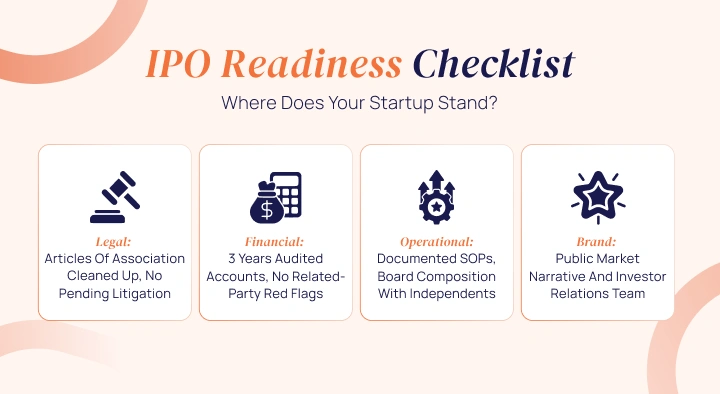
Checklists bring clarity to a complex process like an IPO, where multiple moving parts need to align. They help founders identify gaps early and ensure nothing critical is missed under pressure:
-
Financials audited for 3+ years
-
Full Ind AS compliance implemented
-
Strong internal financial controls (IFC)
-
Clear cap table and no legal disputes
-
Defined growth strategy post-IPO
-
Leadership team ready for public scrutiny
-
ESG and governance frameworks in place
-
Data room prepared for IPO due diligence checklist
Common Mistakes Indian Startups Make Before Filing a DRHP
-
Treating IPO as an Exit: It’s a transition to a “permanent” business.
-
Weak Compliance: Ignoring Ind AS until the last minute.
-
Inconsistent Narratives: Discrepancy between PR and actual DRHP filings.
-
Overdependence on Founders: Lack of “Second-in-Command” leadership.
-
Poorly Drafted DRHP: Incomplete disclosures lead to SEBI “observations” and delays.
How Pre-IPO Mentorship Changes Your Trajectory
Pre-IPO mentorship is needed because going public is a strategic transition. A mentor helps with:
-
Positioning your company for institutional investors
-
Identifying gaps in governance
-
Preparing founders for public market scrutiny
Platform Highlight: Mr CEO offers an investment-backed approach to IPO preparation, focusing on strategic mentorship and real-world experience to ensure faster approvals and better valuations.
Summary & Conclusion
The startup IPO India journey in 2026 is no longer about chasing headlines—it’s about building IPO-ready companies from day one.
Founders who succeed in public markets focus on:
- Financial discipline
- AI-driven operational efficiency
- Strong governance frameworks
IPO readiness is not a checklist you complete but a system you build over time.
If you’re planning to go public, the real question is not “When should we file our DRHP?” It’s “Are we fundamentally ready for the public markets?”
FAQs on Startup IPO India (People Also Ask)
1. What is the DRHP filing process for startups in India?
The process involves preparing a prospectus with audited financials and risk disclosures, submitting it to SEBI, addressing “observations” from the regulator, and finally filing the RHP (Red Herring Prospectus).
2. What are common reasons why SEBI rejects startup DRHP filings?
Rejections often stem from undisclosed legal disputes, inconsistent financial data, or failure to meet the “Promoter Group” disclosure norms.
3. How many Indian startups filed DRHPs in Q1 2026?
The pipeline remains robust with roughly 15-20 tech-heavy startups filing in Q1, signaling a mature market.
4. What is an IPO readiness checklist for Indian startups?
It must include 3-year audits, Ind AS alignment, a board with independent directors, and a clear “Objects of Issue” for the funds raised.
5. Why is pre-IPO mentorship important for founders?
Mentorship helps founders bridge the gap between “Private Growth” and “Public Accountability,” often resulting in a 15-20% higher valuation at listing.