Table of Contents
- What Is Agentic AI? (And Why It Is Different from Chatbots)
- Why Agentic AI Is Exploding in India Right Now
- 5 Ways Indian Startup Founders Are Already Using Agentic AI
- Building vs. Buying: What Should Indian Founders Do?
- What Investors Are Looking for in AI-First Startups
- Regulatory Warning: Don’t Ignore This
- Action Plan: How to Start Your Agentic AI Journey in 30 Days
- Conclusion
- FAQs
The Agentic AI market is on a steep growth trajectory, set to expand from USD 7.06 billion in 2025 to USD 93.20 billion by 2032, at an impressive CAGR of 44.6%. This surge reflects a fundamental shift toward intelligent software agents capable of autonomous operations.
Indian startups are hitting a ceiling, and most founders don’t even realize why.
You have optimized your SaaS stack, automated workflows, hired lean teams, and maybe even plugged in some AI tools. Yet, growth still feels linear when it should be exponential.
Here’s the uncomfortable truth: using AI tools is no longer a competitive advantage.
The real shift is happening right now. It may seem quiet, but the shift from tools to autonomous systems is accelerating faster than most roadmaps anticipate. Startups that understand this shift are building companies where work happens without constant human prompting. The rest are just adding AI as a feature and calling it innovation.
Welcome to the era of Agentic AI, and if you’re building in India, this could be your biggest leverage before 2027.
What Is Agentic AI? (And Why It Is Different from Chatbots)
Agentic AI refers to AI systems (agents) that can plan, decide, and execute tasks autonomously, rather than just responding to prompts like traditional chatbots.
Unlike chatbots that wait for instructions, AI Agents act like autonomous digital employees—they can manage workflows, make decisions based on context, and continuously improve outcomes.
In short:
- Chatbots = reactive
- Agentic AI = proactive, goal-driven
Why Agentic AI Is Exploding in India Right Now
India is not just adopting agentic AI trends but also accelerating them. Here’s why:
1. Cost Pressure + Talent Gap
Indian startups operate under extreme cost discipline. Hiring 5 more people vs. deploying 5 autonomous workflow AI agents are now a real decision to make.
2. SaaS Fatigue
Founders are tired of paying for 10–15 disconnected tools. The shift toward replacing SaaS tools with autonomous AI agents is already underway.
3. API + Open-Source Ecosystem
India’s developer ecosystem is rapidly adopting open frameworks like LangChain, AutoGen, and open LLMs, making Agentic AI more accessible than ever.
4. Founder Mindset Shift
The new question isn’t “Which tool should I use?” It’s “Which workflow can I fully automate?”
5. Global Competition
Indian startups are no longer competing locally. With global SaaS and AI players entering the market, efficiency via AI leverage is survival, not luxury.
5 Ways Indian Startup Founders Are Already Using Agentic AI
Here’s how Agentic AI for startups is being implemented on the ground—no fluff, just real use cases:
1. Customer Support Automation (70–80% Cost Reduction)
- AI agents handle FAQs, ticket routing, and even resolution
- Example: D2C brands using agents to manage WhatsApp + email queries
- Result: Reduced support headcount by up to 60%
2. Sales Prospecting & Outreach
- Agents scrape leads, qualify them, and send personalised outreach
- Tools like Apollo + AI agents are replacing SDR teams partially
- Conversion rates improved by 20–30% due to personalization
3. Content & SEO Engines
- Founders are building workflow AI agents that:
- Generate blogs
- Optimize SEO
- Publish automatically
- Outcome: 5x content output without hiring writers
4. Finance & Ops Automation
- Invoice processing, expense categorisation, and compliance tracking
- Agents reduce manual accounting tasks significantly
- Especially useful for early-stage startups
5. Hiring & Screening
- AI agents screen resumes, shortlist candidates, and schedule interviews
- Cuts down hiring cycle time by 40–50%
Benchmark: Startups implementing AI Agents across workflows report up to 3–5x operational efficiency gains within 3–6 months.
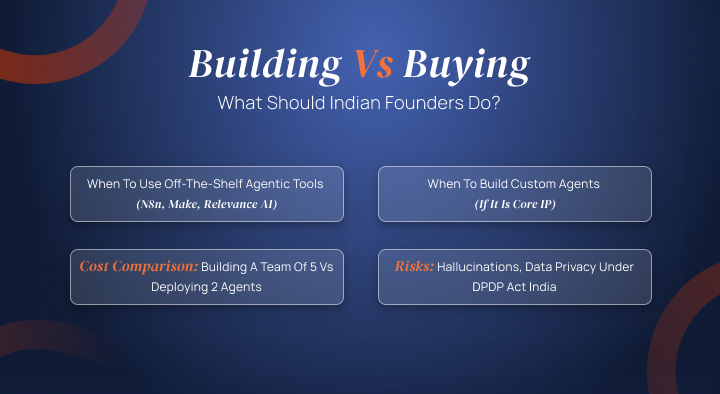
Building vs. Buying: What Should Indian Founders Do?
This is where most founders get stuck.
The Old Approach
- Buy SaaS tools
- Integrate them
- Hire people to operate them
The New Approach
- Build or deploy AI Agents that replace entire workflows
The Shift from Tools to Agents
Instead of asking, “Which CRM should I use?”
You now ask: “Can an AI agent handle my entire sales pipeline?”
That’s the mindset shift that underpins AI agency for startups.
The India Advantage
India has a unique edge here:
- Affordable developer talent
- Strong engineering ecosystem
- Growing AI-first founder community
- Cost sensitivity driving innovation
This makes building custom AI agents far more viable in India than in the West.
What Investors Are Looking for in AI-First Startups
Whether in Bangalore or Silicon Valley, the investor thesis has shifted from ‘AI-enabled’ to ‘AI-native.’ Globally, VCs are backing founders who treat agents as core infrastructure that decouples revenue growth from headcount growth.
In India, this is amplified by a focus on unit economics—investors want to see how agentic workflows drive margin expansion and capital efficiency, not just top-line hype.
1. What Is Your AI Leverage Ratio?
This is no longer a fancy term; it’s a filtering question. Investors want to know: How much output are you generating per employee because of AI?
If your team of 10 is operating like a team of 30 using Agentic AI, you’re already ahead. If not, you’re seen as operationally heavy.
2. AI-First Startups Get Higher Valuations
AI Agent-based startups, not just those that use them, are receiving premium attention.
Why? Because they show:
- Higher margins
- Faster scalability
- Lower dependency on hiring
In simple terms: Less burn. More output. Better multiples.
3. Red Flag: AI as a Feature vs AI as the Operating System
This is where many founders lose investor interest. If your pitch says, “We use AI for recommendations.”
It sounds incremental. But if you say, “Our core operations run on autonomous workflow AI agents.”
It signals a fundamentally different business model. Investors aren’t backing AI-enabled startups anymore; they are backing AI-native companies.
4. How to Pitch Your Agentic AI Advantage
Here’s how to make your pitch land:
- Show before vs after AI transformation (time, cost, output)
- Quantify your AI Leverage Ratio clearly
- Highlight workflows fully handled by AI Agents
- Demonstrate how growth does NOT require proportional hiring
Make it visible. Make it measurable.
Where Mr CEO Can Help (Subtle but Strategic)
This is exactly where platforms like Mr CEO quietly become a force multiplier.
Instead of you manually figuring out:
- Which workflows to automate
- How to structure your AI Leverage Ratio
- What metrics actually impress investors
Mr CEO helps you:
- Identify high-impact workflows that can be converted into agentic systems
- Turn scattered AI usage into a cohesive AI-first operating model
- Generate investor-ready narratives backed by real efficiency metrics
Think of it less as a tool and more as an AI-first co-pilot that helps you think, operate, and pitch like an AI-first founder. Because at this stage, it’s not just about using AI. It’s about proving that your startup runs better because of it.
Regulatory Warning: Don’t Ignore This
With the Digital Personal Data Protection (DPDP) Act coming into force in India, AI startups must rethink how agents handle data.
Key Risks:
- Unauthorized data processing
- Lack of user consent
- Storing sensitive personal data
What Founders Must Do:
- Ensure data consent flows are clear
- Avoid training AI on private user data without compliance
- Implement audit trails for AI decisions
For example, if your agent processes customer emails, you must explicitly state this in your privacy policy and allow opt-out. Ignoring compliance can derail your funding rounds and erode trust faster than bad product-market fit.
Action Plan: How to Start Your Agentic AI Journey in 30 Days
Here’s a practical roadmap to implement AI agentics for startups immediately:
Week 1: Map Your 3 Most Repetitive Workflows
- Customer support
- Lead generation
- Internal reporting
Week 2: Identify Existing Agent Capabilities
- Check the tools you already use
- Many now offer built-in AI Agents
Week 3: Run a Pilot
- Choose ONE workflow
- Deploy ONE agent
- Measure output (time saved, cost reduced)
Conclusion
The biggest mistake Indian founders can make right now is treating AI like a feature instead of infrastructure. Agentic AI for startups is not just another trend—it’s a fundamental shift in how companies operate. The winners before 2027 will not be the ones using the best tools but the ones building the most efficient autonomous systems. If you start now, you’re early. If you wait, you’re competing on yesterday’s terms.
FAQs
1. What is Agentic AI for startups, and how is it different from traditional AI tools?
“Agentic AI for startups” refers to using autonomous AI agents that can execute tasks end-to-end without constant human input. Unlike traditional AI tools that require prompts, agentic AI systems can plan, act, and optimize workflows independently.
2. How to use AI agents to scale an Indian startup?
To scale using AI Agents, founders should:
- Identify repetitive workflows
- Deploy agents for automation
- Measure efficiency gains
- Gradually replace manual processes
This approach increases output without increasing team size.
3. What are the top AI agent tools for founders in India 2026?
Some of the Top AI agent tools for founders in India in 2026 include:
- AutoGen
- LangChain
- CrewAI
- OpenAI Agents APIs
- Zapier AI Agents
These tools help build and deploy workflow AI agents across functions.
4. What is the cost of building vs. buying AI agents for SaaS startups?
The cost of building vs. buying AI agents for SaaS depends on scale:
- Buying tools: Lower upfront cost, higher long-term subscription cost
- Building agents: Higher initial investment, lower long-term cost, and better control
For Indian startups, building often becomes more cost-effective over time.
5. How does the DPDP Act impact AI startups in India?
The DPDP Act compliance for AI startups in India requires:
- Clear user consent
- Secure data handling
- Transparency in AI decisions
Non-compliance can lead to penalties and loss of user trust, making it critical for startups using Agentic AI.