Table of Contents
- Quick Answer: What Are the Main Types of Startup Investments?
- What Is Startup Investment, and How Does It Work?
- What Are the Different Types of Startup Investments?
- How Do Startup Investments Change Across Funding Stages?
- How Are Startup Investments Structured in India?
- Where Can Indian Startups Find Investors and Funding?
- What Mistakes Should Founders Avoid When Raising Startup Investments?
- The Right Capital Matters More Than the Biggest Investment
- FAQs on Startup Investments
Raising money for a startup sounds like progress. But is every investment actually good for the business? A founder might give away too much equity to raise capital that wasn't needed. Another might take a loan without considering what happens when revenue slows down. The problem isn't always finding money. It's understanding what that money demands in return. Choosing the right startup investment means looking beyond the amount offered. You need to consider ownership, repayment obligations, investor expectations, and what the business can realistically achieve with the capital.
Quick Answer: What Are the Main Types of Startup Investments?
The main types of startup investments are equity investment, where investors receive company shares, and debt financing, where startups borrow capital and repay it under agreed terms.
Other startup funding options include bootstrapping, angel investment, venture capital, government grants, accelerators, and crowdfunding.
Equity is generally suitable for startups seeking growth capital without scheduled loan repayments. Debt may suit businesses with predictable cash flow. Grants and bootstrapping can help founders raise or use capital without giving up ownership.
What Is Startup Investment, and How Does It Work?
Equity vs Debt Financing for Startups
Understanding equity vs debt financing for startups is important because both options create different financial obligations.
1. Equity Financing
Equity financing involves raising capital by selling a percentage of business ownership to investors.
- Capital arrangement: Investors receive shares in the business.
- Ownership: Existing shareholders experience ownership dilution.
- Repayment: No scheduled loan repayments are required.
- Main cost: Sharing business ownership and granting investor rights.
- Main risk: Dilution of ownership and potential loss of control.
2. Debt Financing
Debt financing involves borrowing money that the business must repay over an agreed period, usually with interest.
- Capital arrangement: The business borrows money from a lender.
- Ownership: Existing ownership generally remains unchanged.
- Repayment: Regular repayments are mandatory.
- Main cost: Interest payments and associated fees.
- Main risk: Cash-flow pressure and potential default if repayments are missed.
The decision isn’t simply about which option costs less today.
With equity, you share the future value of your business. With debt, you commit future cash flow.
India’s Startup India funding guide explains these financing differences and the funding sources available at different business stages.
What Are the Different Types of Startup Investments?
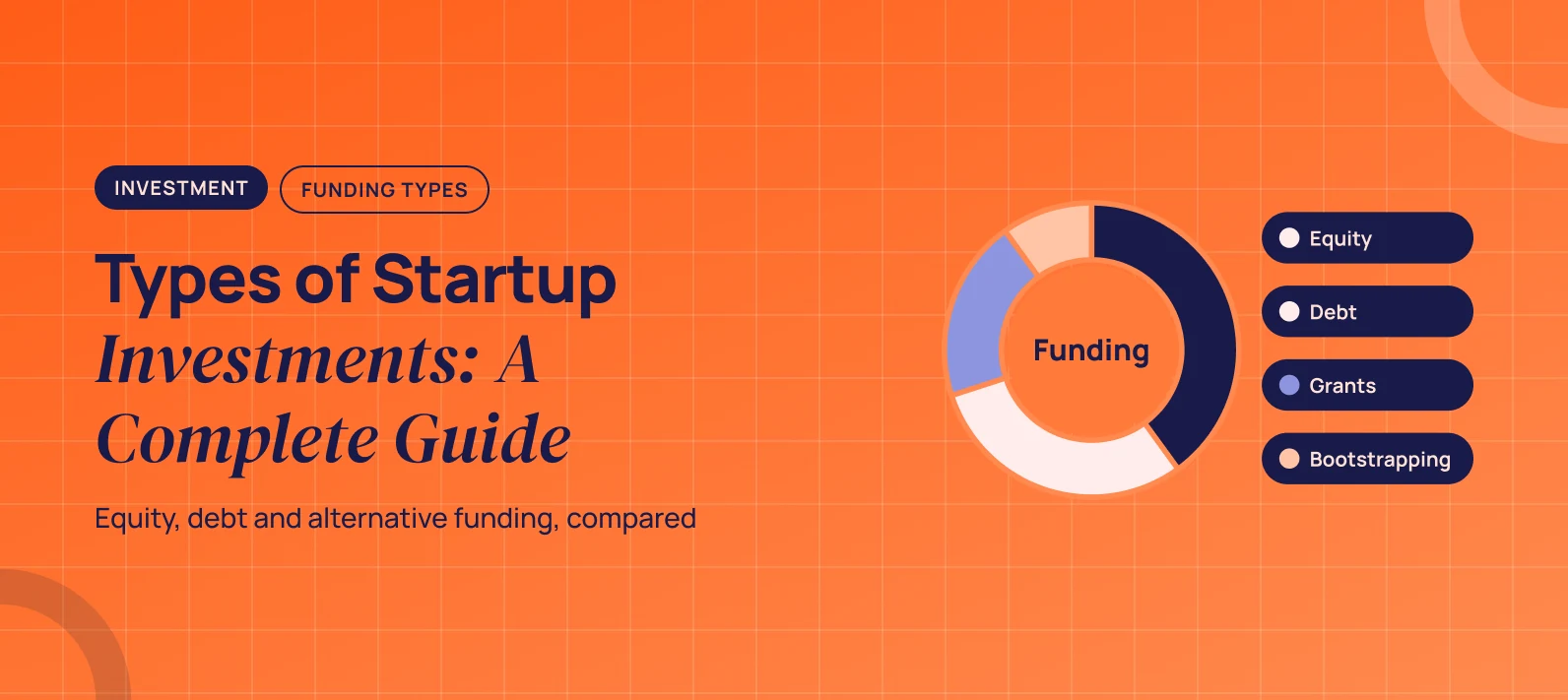
The different types of startup funding can be grouped into four categories: self-funding, equity investments, debt financing, and alternative funding.
1. Self-Funding and Personal Network Investments
Bootstrapping
Bootstrapping means building a business with personal savings or revenue generated by the company.
It allows founders to retain ownership and make decisions independently. But limited capital can slow product development, hiring, and expansion.
Best suited for: Startups that can validate customer demand without significant external funding.
Friends and Family Funding
Founders may raise initial capital from relatives or friends through loans, gifts, or equity arrangements.
The process can be less formal than institutional fundraising, but the financial arrangement should still be documented.
A failed investment should not become an unexpected personal dispute.
Best suited for: Early-stage businesses seeking capital before approaching professional investors.
2. Equity-Based Startup Investments
Angel Investors
An angel investment comes from an individual investing personal wealth in a startup, commonly in exchange for equity.
Some angels also provide industry knowledge, introductions, and mentorship.
Consider two investors offering the same amount. One only provides capital. The other understands your market and can introduce your business to potential customers.
The second investor may offer greater strategic value, even when the financial terms are similar.
Best suited for: Startups with a credible founding team, a promising idea, or early customer validation.
Seed Funds and Micro VCs
Seed funds invest professionally managed capital in early-stage companies.
They typically evaluate the market opportunity, founding team, product, and early signs of demand.
Best suited for: Startups preparing to validate or scale their initial business model.
Venture Capital (VC)
Venture capital firms invest in startups with the potential to achieve substantial growth.
VC funding can support customer acquisition, product development, recruitment, and market expansion.
But VC investors generally expect significant returns, which can influence growth targets and future fundraising decisions.
Not every profitable business needs venture capital. A company pursuing steady, sustainable growth may be better served by another financing method.
Best suited for: Startups operating in large markets with scalable business models.
India also supports venture capital through the government-backed Fund of Funds for Startups (FFS).
According to the Ministry of Commerce and Industry, SEBI-registered Alternative Investment Funds supported by FFS had invested ₹25,547.98 crore in 1,371 startups as of December 31, 2025.
The scheme channels government capital through investment funds rather than investing directly in individual startups.
Corporate Venture Capital (CVC)
Corporate venture capital involves investments made through the venture arms of established businesses.
Startups may receive industry expertise, technology access, and commercial partnerships alongside funding.
However, founders should evaluate restrictions that could affect future customers, partnerships, or investors.
Best suited for: Startups seeking strategic partnerships alongside growth capital.
Family Offices
Family offices manage the investments of wealthy families, sometimes including stakes in startups.
Their expectations, investment horizons, and involvement vary.
Best suited for: Businesses whose growth plans align with a family office’s investment objectives.
Private Equity (PE)
Private equity firms generally invest in established companies, including mature and late-stage startups.
They may provide expansion capital or acquire substantial ownership stakes, sometimes with greater involvement in business operations.
Best suited for: Established businesses with proven performance and larger capital requirements.
3. Debt-Based Startup Financing
Bank Loans and NBFC Financing
Banks and Non-Banking Financial Companies (NBFCs) provide loans that businesses must repay with interest.
Lenders typically evaluate financial performance, repayment capacity, and security requirements.
For Indian startups, the Credit Guarantee Scheme for Startups supports eligible lending institutions that finance DPIIT-recognised startups.
Under its revised framework, guarantee coverage can extend up to ₹20 crore per eligible borrower. This is a guarantee limit for lenders, not an assured loan amount for startups.
Best suited for: Businesses with sufficient revenue or reliable cash flow to support repayments.
Venture Debt
Venture debt is specialized debt financing, often used by startups that have already raised institutional equity capital.
It can help extend operating runway without immediately selling additional shares.
However, interest, repayment schedules, loan conditions, and possible warrants must be evaluated.
Best suited for: Venture-backed startups with a credible repayment plan.
Revenue-Based Financing
Revenue-based financing provides capital in exchange for an agreed share of future revenue, often until a predetermined amount is repaid.
Repayments can move with sales, but the total cost may still be substantial.
Best suited for: Businesses with predictable revenue, including established SaaS and ecommerce companies.
4. Alternative Startup Funding Options
Government Grants and Subsidies
Government grants can help eligible startups develop products, test ideas, and enter markets without immediately surrendering equity.
For example, the Startup India Seed Fund Scheme (SISFS) provides eligible startups with:
- Up to ₹20 lakh as a grant for proof of concept, prototype development, or product trials.
- Up to ₹50 lakh through debt, convertible debentures, or debt-linked instruments for commercialization and scaling.
These amounts represent different financing categories. The ₹50 lakh component is not a grant.
As of December 31, 2025, selected incubators under SISFS had approved ₹590.93 crore in assistance to 3,271 startups.
Sources: Startup India Seed Fund Scheme and Ministry of Commerce and Industry, February 2026.
Incubators and Accelerators
Incubators support startups as they develop ideas and business models. Accelerators commonly provide structured, time-limited programs to help businesses progress faster.
Support may include mentoring, workspace, investor introductions, or capital. Some programs take equity, while others operate through grants or different arrangements.
Crowdfunding
Crowdfunding raises money from multiple contributors, often through online platforms.
Common models include donation-based and reward-based crowdfunding, where contributors do not receive company shares.
Equity crowdfunding is different. In India, founders cannot assume they can publicly sell private-company shares through an online platform.
SEBI’s warning on unauthorised electronic fundraising platforms highlights the securities-law risks involved.
Founders considering public fundraising should obtain legal advice on the applicable Indian regulations.
How Do Startup Investments Change Across Funding Stages?
A startup’s investment options change as the business develops.
An idea-stage founder needs money to validate a concept. A growing company might need capital to enter new markets.
The funding source should match the business objective.
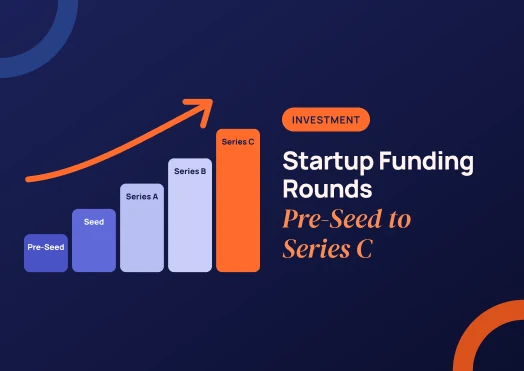
Pre-Seed Stage
Main objective: Validate an idea and develop a Minimum Viable Product (MVP).
Common funding sources:
- Bootstrapping
- Family and friends
- Angel investors
Seed Stage
Main objective: Establish customer demand and test product-market fit.
Common funding sources:
- Angel investors
- Seed funds
- Accelerators
Series A
Main objective: Scale a repeatable business model.
Common funding sources:
- Venture capital firms
Series B
Main objective: Expand operations and enter new markets.
Common funding sources:
- Growth-stage venture capital firms
- Strategic investors
Series C and Beyond
Main objective: Support major expansion or acquisitions.
Common funding sources:
- Late-stage venture capital firms
- Private equity firms
These stages are common patterns, not mandatory steps.
A profitable company might never raise Series A funding. Another may require substantial early investment because product development is expensive.
Funding rounds should follow business requirements, not become business objectives themselves.
How Are Startup Investments Structured in India?
The investor provides the money. The investment structure determines the rights and obligations attached to it.
Indian founders should understand these common arrangements.
Equity Financing
Investors purchase shares at an agreed valuation.
The resulting ownership percentage and investor rights depend on the agreed terms, share classes, and capitalization structure.
Convertible Notes
Convertible notes allow eligible startups to receive funds that may convert into equity later.
According to the Ministry of Commerce and Industry’s February 2026 statement, qualifying Indian startups can receive ₹25 lakh or more from a person in a single tranche through a convertible note that converts into equity or is repayable within a period not exceeding ten years.
Other legal and regulatory conditions also apply.
SAFE and iSAFE
A SAFE (Simple Agreement for Future Equity) provides contractual rights to future equity under specified conditions.
However, a standard US-style SAFE should not be assumed to satisfy India’s company law and foreign-investment requirements.
The India-specific iSAFE developed by 100X.VC uses Compulsorily Convertible Preference Shares (CCPS) as its legal structure.
According to 100X.VC’s original iSAFE documentation, the instrument is designed to provide SAFE-like funding economics through an Indian convertible security.
Founders should have the proposed instrument reviewed for applicable company law, tax, and FEMA compliance.
How Does Equity Investment Affect Founder Ownership?
Suppose you own 100% of a startup valued at ₹8 crore before funding.
An investor offers ₹2 crore.
Understanding Founder Dilution: An Example
Pre-money valuation: ₹8 crore
New investment: ₹2 crore
Post-money valuation: ₹10 crore
The investor’s ownership is calculated as:
Investor ownership = Investment ÷ Post-money valuation × 100
₹2 crore ÷ ₹10 crore × 100 = 20%
The resulting ownership structure is:
- Investor ownership: 20%
- Founder ownership: 80%
You now own 80% of the company rather than 100%.
The calculation assumes no other shareholders, employee option pool adjustments, or convertible instruments.
The investor’s capital may help the business grow, but future rounds can dilute ownership further.
The question isn’t whether dilution is always bad. It’s whether the value created by the investment justifies the ownership you surrender.
Where Can Indian Startups Find Investors and Funding?
Indian founders can explore angel networks, venture capital firms, incubators, accelerators, banks, NBFCs, and government-backed programs.
Useful starting points include:
- Startup India Investor Connect — For connecting with investors through the Startup India ecosystem.
- Startup India Seed Fund Scheme — For eligible early-stage funding assistance.
- Credit Guarantee Scheme for Startups — For information on credit guarantee-backed lending.
- SEBI’s registered Alternative Investment Funds — For verifying registered investment funds.
Before approaching investors, prepare financial projections, customer evidence, funding requirements, and a clear plan for using the capital.
What Mistakes Should Founders Avoid When Raising Startup Investments?
- Raising without a purpose: Funding should support a measurable milestone.
- Chasing the highest valuation: A higher valuation doesn’t automatically mean better investment terms.
- Ignoring dilution: Understand what current and future rounds mean for ownership.
- Underestimating debt obligations: Test repayments against realistic cash-flow scenarios.
- Choosing investors only for their money: Evaluate expertise, expectations, and strategic fit.
- Signing without reviewing terms: Examine liquidation preferences, governance rights, repayment clauses, and restrictions.
One question can expose several of these risks:
What happens to the business if the expected growth doesn’t happen on time?
A financing arrangement should remain manageable even when the original plan changes.
The Right Capital Matters More Than the Biggest Investment
A large investment can accelerate growth. It can also create obligations that the business isn’t ready to handle.
Before choosing startup financing, understand what the capital will help you achieve, what it costs, and how much flexibility remains afterward.
The right business investment should help a startup reach its next milestone without compromising its ability to make sound decisions when circumstances change.
Raise capital to build a stronger business. Not simply to announce a bigger funding round.
FAQs on Startup Investments
1. What Is the Most Common Type of Startup Investment?
There is no single type suitable for every startup. Bootstrapping and personal-network funding are common early options, while angel investors, venture capital, and debt financing serve different stages and business requirements.
2. What Is the Difference Between Angel Investment and Venture Capital?
Angel investors generally invest personal money, whereas venture capital firms invest professionally managed funds. Their investment sizes, processes, and growth expectations may differ.
3. Can Indian Startups Raise Funding Without Giving Up Equity?
Yes. Bootstrapping, eligible government grants, bank loans, and certain debt financing arrangements can provide capital without issuing shares. However, debt creates repayment obligations, and some instruments may carry rights to future equity.
4. Which Funding Option Is Best for an Early-Stage Startup?
Bootstrapping, government grants, incubators, accelerators, and angel investors may be suitable depending on funding needs, business validation, and growth potential.
5. How Do Startup Investors Make Money?
Equity investors generally seek returns when their shares increase in value and can be sold through acquisitions, secondary transactions, or public listings. Debt investors earn interest and applicable fees.
Actual returns depend on the business’s performance and investment terms.