Table of Contents
- Quick Answer: What Do Investors Look for in a Startup in 2027?
- Why Are Investor Expectations Changing in India in 2027?
- What Do Investors Look for in a Startup Before Investing?
- How Can Indian Founders Prove Their Startups Are Investment-Worthy?
- How Do Investor Expectations Differ by Funding Stage?
- Which Startup Sectors Could Attract Investors in India in 2027?
- How Do Startup Investors Evaluate a Business Before Funding?
- What Are the Biggest Red Flags for Startup Investors?
- How Can Indian Founders Prepare for Startup Funding in 2027?
- Building a Startup That Investors Want to Back
- FAQs on Startup Investors in 2027
A founder walks into an investor meeting with a promising idea, an ambitious growth plan, and a well-designed pitch deck.
But what happens when the investor asks a simple question: Who is paying for your product?
A good idea can start a conversation. It cannot answer every question about the business.
For founders seeking startup funding in 2027, the challenge is to show that the company can solve a real problem, attract customers, and grow without losing control of its finances.
And startup investors don’t evaluate every company the same way. A pre-seed startup may have little revenue to show, while a Series A company needs stronger proof that its growth can continue.
Understanding these differences can help founders build a business that investors have good reasons to support.
Quick Answer: What Do Investors Look for in a Startup in 2027?
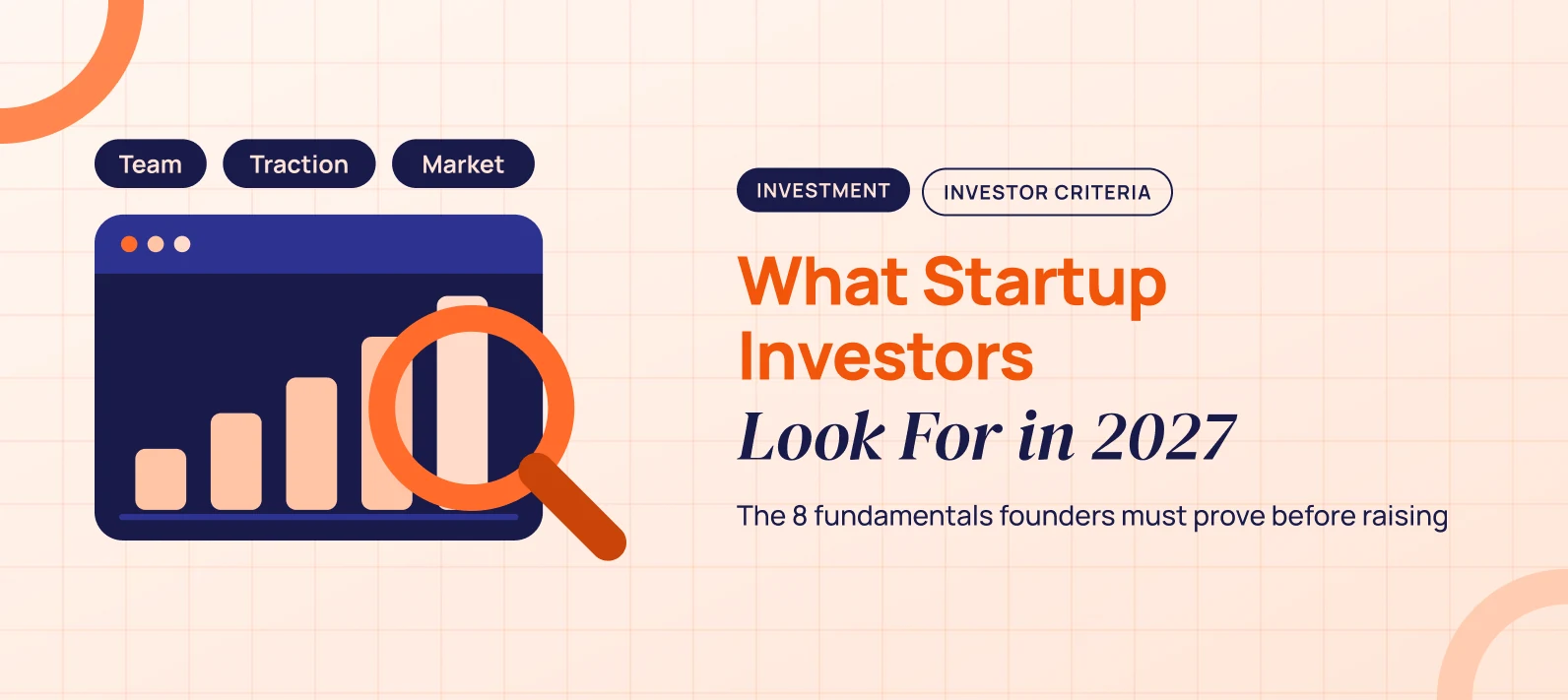
Startup investors entering 2027 will likely focus on six fundamentals: capable founders, genuine market demand, measurable customer traction, a scalable business model, healthy unit economics, and a competitive advantage. The evidence they expect depends on the funding stage. Above all, investors need confidence that the team can turn its business opportunity into sustainable, long-term value.
Why Are Investor Expectations Changing in India in 2027?
India has plenty of entrepreneurs building new businesses. The harder question is how many of those businesses can attract investment and deliver the returns investors expect.
According to an August 2026 parliamentary reply published by the Ministry of Science and Technology, India had more than 2.40 lakh DPIIT-recognised startups.
The funding picture tells a different story.
Inc42’s Indian Tech Startup Funding Report for Q3 2026 reported that Indian technology startups raised US$2.2 billion across 210 deals between July and September 2026.
Funding increased by 5% compared with the same quarter in 2025, but the number of deals fell by 13%.
These figures cover different populations: DPIIT recognition is a cumulative government measure, while Inc42 tracks funding transactions in its defined technology-startup market. They should not be compared as if every recognised startup were seeking venture funding.
Still, the investment data indicates that more funding does not necessarily mean more companies receive it.
Three developments are especially relevant to founders preparing for 2027.
1. Financial Discipline Matters Alongside Growth
Growing revenue is encouraging. But what if the business spends more on acquiring customers than those customers generate in value?
Investors examine whether the money a startup spends produces meaningful commercial progress.
A company may grow quickly and still struggle to attract investment if its operating costs, customer acquisition expenses, and cash consumption remain difficult to control.
The goal isn’t always immediate profitability. It’s showing that the business understands its economics and has a credible plan for improving them.
2. Execution Matters More Than Promises
An ambitious product roadmap looks impressive until the team struggles to deliver it.
Investors examine what founders have already accomplished with their available resources.
That includes launching products, learning from customers, addressing problems, and converting early interest into commercial results.
A smaller startup that consistently delivers meaningful progress may present a stronger investment case than a larger company that repeatedly misses its milestones.
3. Differentiation Must Survive Competition
Technology is becoming easier to access. Building a product is only part of the challenge.
Why would customers choose one startup over another? And what would stop a competitor from offering the same solution?
These questions matter especially in crowded technology markets.
The stronger businesses can explain what makes their offering valuable, how they reach customers, and why those advantages may last.
The lesson for founders: Raising capital should support a clear business opportunity. It shouldn’t become the business strategy itself.
What Do Investors Look for in a Startup Before Investing?
Startup investors examine the people building the company, the problem it solves, the customers it serves, and its potential to generate returns.
Here are the factors founders should prepare to demonstrate.
1. A Real Customer Problem Worth Solving
Investors look for businesses that solve problems customers care enough about to pay for.
A product can be innovative without being commercially useful.
Consider two software products.
One helps logistics companies reduce failed deliveries and related costs. The other introduces minor improvements to an existing reporting dashboard.
Both may be technically sound. But the first has a clearer economic benefit if it can demonstrate measurable savings.
That benefit gives potential customers a stronger reason to buy.
Before seeking investment, founders should answer five questions:
- Who experiences the problem?
- How often does it happen?
- What does it cost customers?
- How do customers deal with it today?
- Why would they pay for a different solution?
What investors want to see: Customer interviews, paid pilots, repeat purchases, purchase commitments, or evidence that existing solutions fail to meet customer needs.
Customer interest is useful. Customers taking action is stronger evidence.
2. A Large and Accessible Market Opportunity
Investors want to know how much of the market a startup can realistically serve and capture.
A large industry doesn’t automatically create a large business.
Founders should understand three market-sizing concepts.
| Market measure | What it means |
|---|---|
| Total Addressable Market (TAM) | The total potential demand for the product |
| Serviceable Addressable Market (SAM) | The portion the startup can serve with its current offering and reach |
| Serviceable Obtainable Market (SOM) | The share the startup could realistically capture within a defined period |
Consider an Indian startup developing inventory software for independent pharmacies.
The overall Indian healthcare market says little about the company’s immediate opportunity.
A more useful estimate starts with the pharmacies it can reach, their current inventory-management problems, their software budgets, and the amount they may be willing to pay.
That creates a clearer picture of potential customers and revenue.
Investors also want to understand the competition. A promising market opportunity must leave room for the startup to acquire and retain customers profitably.
What investors want to see: Defensible market calculations, customer segments, purchasing behaviour, competitor analysis, and a practical expansion plan.
3. A Founding Team That Can Execute
Investors back people who understand their market and can turn decisions into results.
At the pre-seed stage, a startup may not have substantial revenue or years of operating history.
This makes the founding team’s capabilities especially important.
Relevant founder experience can come from working in the industry, building technology, managing teams, selling products, or dealing directly with the problem the business intends to solve.
But an impressive background is not enough.
Investors also examine how founders make decisions, respond to setbacks, work together, and fill gaps in their expertise.
A founder who knows the technology but cannot explain the customer may face difficult questions. So can a founder with strong sales experience but no clear plan for building the product.
What investors want to see: Relevant expertise, complementary skills, leadership responsibilities, previous achievements, and evidence of execution.
4. Measurable Business Traction and Customer Validation
Business traction shows whether customers use a startup’s product, pay for it, and return.
Imagine a mobile application that records 50,000 downloads.
That figure sounds promising. But how many people use the application regularly? How many become paying customers? And how many return the following month?
Without those answers, downloads reveal little about the quality of customer demand.
Now consider a smaller application with fewer users but consistent retention and increasing paid subscriptions.
It may provide more convincing evidence of a sustainable business.
Investors commonly examine:
- Paying customers and repeat purchases.
- Active users and customer retention.
- Revenue from new and existing customers.
- Commercial pilots and signed contracts.
- Referrals and organic customer growth.
The right measures depend on the business.
A D2C brand might track repeat purchase rates and contribution margins. An enterprise SaaS startup might focus on recurring revenue, contract renewals, and customer retention.
What investors want to see: Reliable data showing that customers continue finding value in the product.
5. A Scalable and Sustainable Business Model
Investors want to understand how a startup makes money and what happens to its costs as it grows.
A good business model answers four basic questions:
Who pays? What do they pay for? How much do they pay? Why will they continue paying?
- For a SaaS company, revenue may come from monthly subscriptions or annual contracts.
- For a marketplace, it may come from transaction commissions.
- For a D2C brand, investors will examine product margins, repeat purchases, fulfilment costs, and customer acquisition.
The challenge is building a model that can expand without requiring a disproportionate increase in spending.
If every new customer demands expensive customisation or constant attention from the founding team, scaling may become difficult.
What investors want to see: Clear revenue streams, validated pricing, realistic operating costs, and a repeatable customer acquisition process.
6. Healthy Unit Economics and Financial Discipline
Unit economics help investors understand whether acquiring and serving customers makes financial sense.
A startup can report impressive revenue growth and still have weak financial foundations.
For example, consider a D2C company spending ₹1,500 to acquire a customer who makes a single ₹1,000 purchase.
Without additional purchases or sufficient margins, the company may struggle to recover its acquisition costs.
This is why investors look beyond revenue.
| Financial metric | What it helps investors understand |
|---|---|
| Customer Acquisition Cost (CAC) | Average cost of acquiring a customer |
| Customer Lifetime Value (LTV) | Expected customer value over the relationship |
| Gross margin | Revenue remaining after direct costs |
| Burn rate | How quickly the company consumes cash |
| Cash runway | How long available funds can support operations |
| CAC payback period | How long it takes to recover acquisition costs |
Example: How Much Runway Does an Indian Startup Have?
Suppose a startup has ₹36 lakh in available cash and spends ₹3 lakh more than it receives each month.
Cash Runway = Available Cash ÷ Monthly Net Burn Rate
₹36,00,000 ÷ ₹3,00,000 = 12 months
The company has approximately 12 months of runway if its net burn rate remains unchanged.
But that number raises another question.
What can the founders achieve in those 12 months?
Investors want to know whether the available capital can support meaningful milestones, such as reaching a revenue target, improving retention, completing development, or preparing for the next funding round.
What investors want to see: Accurate financial records, sensible forecasts, manageable spending, and evidence that capital produces progress.
7. A Competitive Advantage That Is Hard to Copy
Investors look for reasons a startup can remain valuable even when competitors enter its market.
These advantages are often called competitive moats.
They may include proprietary technology, unique data, exclusive partnerships, strong distribution networks, customer relationships, or products that become difficult to replace.
Consider an AI startup that builds a tool using a widely available third-party model.
The product may be useful, but competitors could develop similar features.
The investment case becomes stronger when the startup also owns valuable data, serves a specialised industry, integrates deeply into customer workflows, or has a proven way to reach buyers.
Technology creates possibilities. The business must turn those possibilities into an advantage.
What investors want to see: Clear evidence of what makes the startup different and why competitors may struggle to reproduce its success.
8. Transparent Reporting and Credible Leadership
Investors need to trust the numbers founders present.
Revenue earned, signed contracts, and potential sales are not the same thing.
A startup that presents its entire sales pipeline as confirmed revenue creates a misleading picture of performance.
Likewise, projected customer growth should not appear alongside actual results without a clear distinction.
Founders should explain their assumptions, acknowledge business risks, and maintain reliable records.
For Indian startups, due diligence may also involve reviewing company filings, shareholding records, applicable GST documentation, intellectual property ownership, and contractual obligations.
What investors want to see: Consistent financial reporting, a clear capitalization table, accurate business metrics, and honest communication.
How Can Indian Founders Prove Their Startups Are Investment-Worthy?
A pitch deck tells investors what founders believe. Supporting evidence shows why those beliefs deserve attention.
This is where many fundraising conversations become difficult.
A founder may claim that customers love the product. The investor may ask to see retention data.
A company may claim that it can become the market leader. The investor may ask what prevents competitors from getting there first.
Here is a practical way to prepare.
| What founders claim | What investors can verify |
|---|---|
| Customers need our product | Paid pilots, customer interviews, repeat purchases |
| Our market is growing | Credible Indian market research and realistic market sizing |
| Customers love our product | Retention data, product usage, referrals |
| We can acquire customers efficiently | CAC, conversion rates, repeatable acquisition channels |
| Our technology is different | Proprietary assets, technical capabilities, defensible integrations |
| We manage funding responsibly | Financial records, burn rate, completed milestones |
| We can scale the business | Revenue performance, operating capacity, expansion strategy |
The Difference Between Attention and Traction
Consider two hypothetical Indian startups.
- Startup A has strong social media engagement, growing website traffic, and an active online community. But it cannot explain how that audience converts into paying customers.
- Startup B has a smaller audience, consistent repeat purchases, measurable acquisition costs, and a sales process that produces reliable results.
Startup B may present a stronger investment case because investors can examine the connection between customer acquisition, revenue, and long-term growth.
That doesn’t make marketing or brand visibility unimportant.
A strong brand can reduce acquisition costs, support customer trust, and create distribution advantages.
But visibility needs to contribute to business outcomes.
A practical test for founders: Review every important statement in your pitch deck. Can you support it with reliable evidence?
If not, you have found something to work on before fundraising.
How Do Investor Expectations Differ by Funding Stage?
Investors generally expect stronger commercial and financial evidence as startups progress through funding rounds.
The same pitch will not work equally well for a newly launched startup and a company preparing for Series A funding.
| Funding stage | What investors generally prioritise | Evidence to prepare |
|---|---|---|
| Pre-seed | Founder capability, problem validation, market potential | Customer research, prototype, early feedback |
| Seed | Initial traction, customer adoption, product-market fit signals | MVP usage, paying customers, pilot results |
| Series A | Repeatable sales, retention, scalable growth | Revenue trends, acquisition costs, unit economics |
| Series B and beyond | Expansion, financial performance, operational maturity | Growth performance, margins, scalable operations |
These are typical expectations rather than fixed requirements.
A deeptech startup may need substantial funding before commercial revenue becomes possible. A software startup may be able to demonstrate recurring revenue much earlier.
The better question is not whether a startup has reached a particular revenue figure. It is whether the company has demonstrated the progress its stage and business model require.
Which Startup Sectors Could Attract Investors in India in 2027?
AI, cleantech, and deeptech entered the final quarter of 2026 with notable funding activity.
According to Inc42’s Q3 2026 startup funding research, these three sectors attracted the following investments:
| Sector | Funding in Q3 2026 |
|---|---|
| Artificial Intelligence | US$438 million |
| Cleantech | US$433 million |
| Deeptech | US$290 million |
These are historical Indian investment figures, not forecasts for 2027.
They provide useful context for founders evaluating emerging sectors, but future funding will depend on investor appetite, commercial progress, valuations, and economic conditions.
AI Infrastructure and Enterprise AI
AI businesses solving specific enterprise problems may attract investor attention.
Potential opportunities include enterprise automation, industry-specific AI applications, AI governance, and security.
The important distinction is between introducing AI into a product and using it to solve a valuable business problem.
An AI product that saves customers measurable time or money may have a stronger commercial argument than one built mainly around the popularity of the technology.
Robotics, Edge AI, and Deep Technology
Robotics, advanced hardware, semiconductors, and edge computing may interest investors seeking significant technological advantages.
These businesses can also face higher development costs, technical risks, and longer commercialization timelines.
Investors need to understand how technical progress will eventually translate into customer adoption and revenue.
Climate Technology and Clean Energy
Indian cleantech startups are exploring areas such as electric mobility, energy efficiency, industrial decarbonization, and renewable energy technologies.
Strong market demand can create opportunities, but investors must also assess deployment costs, commercial feasibility, regulation, and scalability.
The same applies to other emerging sectors.
A popular industry may open the door to investor conversations. It cannot replace a credible business case.
How Do Startup Investors Evaluate a Business Before Funding?
Investors generally assess a startup through initial screening, founder discussions, business evaluation, due diligence, and investment negotiations.
The process differs across angel investors, venture capital funds, and funding stages.
1. Initial Screening
Investors check whether the startup fits their investment strategy.
They consider its industry, stage, market opportunity, team, and funding requirements.
2. Founder Discussions and Product Evaluation
Investors examine the customer problem, business model, competitive advantage, and the founders’ ability to execute.
Product demonstrations and customer evidence can support the discussion.
3. Due Diligence
Investors may review financial statements, customer agreements, statutory records, intellectual property ownership, and business risks.
For Indian companies, founders should maintain accurate documentation relevant to their business structure and applicable regulations.
4. Investment Decision and Valuation
Investors assess the opportunity against its risks and potential returns.
The final decision may involve negotiations over startup valuation, equity ownership, investor rights, and other funding terms.
A company can have a strong product and still struggle to close a round if its valuation or deal structure does not fit investor expectations.
What Are the Biggest Red Flags for Startup Investors?
Investors may hesitate when founders cannot prove customer demand, explain their finances, or demonstrate the ability to execute.
Common warning signs include:
- Unvalidated demand: Customers express interest but do not adopt or pay for the product.
- Vanity metrics: Impressive figures reveal little about sustainable customer value.
- Uncontrolled spending: Expenses increase without corresponding business progress.
- Weak differentiation: Competitors can easily offer similar products.
- Unrealistic projections: Revenue forecasts lack credible assumptions.
- Customer concentration: A small number of clients account for most revenue.
- Poor transparency: Financial records, ownership details, or legal obligations remain unclear.
- Unclear funding requirements: Founders cannot explain how the requested capital will support measurable milestones.
No startup can eliminate every business risk.
The stronger approach is to understand those risks, communicate them clearly, and explain how the team intends to manage them.
How Can Indian Founders Prepare for Startup Funding in 2027?
Founders should approach investors with evidence of demand, reliable business metrics, a clear funding plan, and an understanding of the risks involved.
Before beginning the fundraising process, review the following:
- Validate customer demand. Confirm that customers experience the problem and have reasons to pay for the solution.
- Measure the market. Define the customer segment, calculate the addressable opportunity, and understand the competition.
- Demonstrate traction. Document paying customers, retention, repeat purchases, or successful pilots.
- Understand the finances. Calculate operating costs, margins, burn rate, and cash runway.
- Explain the advantage. Show what makes the product different and why customers may continue choosing it.
- Prepare the documentation. Organize financial statements, company records, contracts, and the capitalization table.
- Define funding requirements. Explain the capital needed, its intended use, and the milestones it should support.
- Identify suitable investors. Research funds and angel investors whose sector, funding stage, geography, and investment approach fit the business.
Where Can Indian Startups Find Investors?
Founders can explore angel investor networks, venture capital firms, incubators, accelerators, startup communities, and relevant industry events.
The Startup India portal also provides information on government startup recognition, support programmes, and available funding initiatives. Founders should verify each programme’s current application status and eligibility before relying on it.
DPIIT recognition and government support programmes serve different purposes from private venture investment. Recognition alone does not guarantee funding.
Does Every Indian Startup Need Venture Capital?
No. A business should seek venture capital when its growth ambitions and capital requirements fit the venture-backed model.
Some startups need substantial investment to develop technology, enter new markets, or build infrastructure.
Others may grow through customer revenue, bootstrapping, grants, or suitable debt financing.
Venture capital usually involves giving investors an ownership stake and pursuing growth capable of generating substantial returns.
For businesses that can grow profitably without significant external funding, retaining ownership and control may be a better option.
The funding strategy should serve the business. The business shouldn’t exist only to raise funding.
Building a Startup That Investors Want to Back
A startup doesn’t become valuable because its pitch deck says it will.
It becomes valuable by solving a problem customers care about, building something they are willing to pay for, and proving that the business can grow.
For founders preparing to raise capital in 2027, the focus should be on what their businesses can demonstrate today and the progress they can realistically achieve tomorrow.
A strong founding team matters. So do market potential, financial discipline, customer traction, and the ability to execute.
The aim isn’t to convince investors that a startup could become successful. It’s to give them enough evidence to understand why it might.
FAQs on Startup Investors in 2027
1. What Are the Five Most Important Things Investors Look for in a Startup?
Investors commonly assess the founding team, market opportunity, customer traction, business economics, and competitive advantage. Each factor helps determine whether a startup can develop into a valuable and scalable business.
2. Can an Indian Startup Get Funding Without Revenue?
Yes. Pre-seed and some seed-stage investors fund companies before they generate revenue. They may assess founder expertise, the customer problem, market opportunity, prototype development, and early signs of customer demand.
3. Do Startup Investors Prefer Profitable Companies?
Not always. Early-stage investors may fund startups that need time and capital before becoming profitable. What matters is whether the spending supports a credible business strategy and whether the company can eventually achieve sustainable economics.
4. How Much Traction Does a Startup Need to Attract Investors?
There is no fixed traction requirement. Early-stage startups may demonstrate progress through customer validation and product development. More mature startups generally need stronger evidence of repeatable acquisition, customer retention, and revenue growth.
5. How Do Startup Investors Determine Valuation in India?
Investors assess market potential, business performance, growth prospects, competitive position, and risks. Comparable funding transactions, industry conditions, and the investment terms can also influence valuation. Founders and investors negotiate the final terms.
6. Are AI Startups More Attractive to Indian Investors in 2027?
AI startups may benefit from continued investor interest, but funding is not guaranteed. Investors still need to understand the customer problem, commercial value, technology, competitive advantage, and financial potential. The level of interest in 2027 will depend on how the sector develops.