Table of Contents
- Quick Answer: What Are the Five Startup Funding Rounds?
- What Are Startup Funding Rounds?
- Startup Funding Stages in India at a Glance
- What Happens at Each Startup Funding Stage?
- How Do Startup Funding Rounds Affect Valuation and Ownership?
- Which Funding Instruments Are Used in India?
- How Much Funding Should an Indian Startup Raise?
- How Can Founders Identify the Right Funding Stage?
- How Can Indian Startups Prepare for Their Next Funding Round?
- What Common Fundraising Mistakes Should Founders Avoid?
- Choosing the Right Startup Funding Round in India
- FAQs on Startup Funding Rounds
Raising capital does not automatically mean a startup is growing in the right direction. A business can secure investment and still struggle to find paying customers. Another can grow without external funding. The difference often lies in how the money is used. Startup funding rounds serve different purposes. Pre-Seed capital helps validate an idea, while later rounds support customer acquisition, scalable operations, and larger expansion plans. For Indian founders, understanding these stages of startup funding is essential before approaching investors. The goal is to raise enough capital to reach the next business milestone without giving up more ownership or control than necessary.
Quick Answer: What Are the Five Startup Funding Rounds?
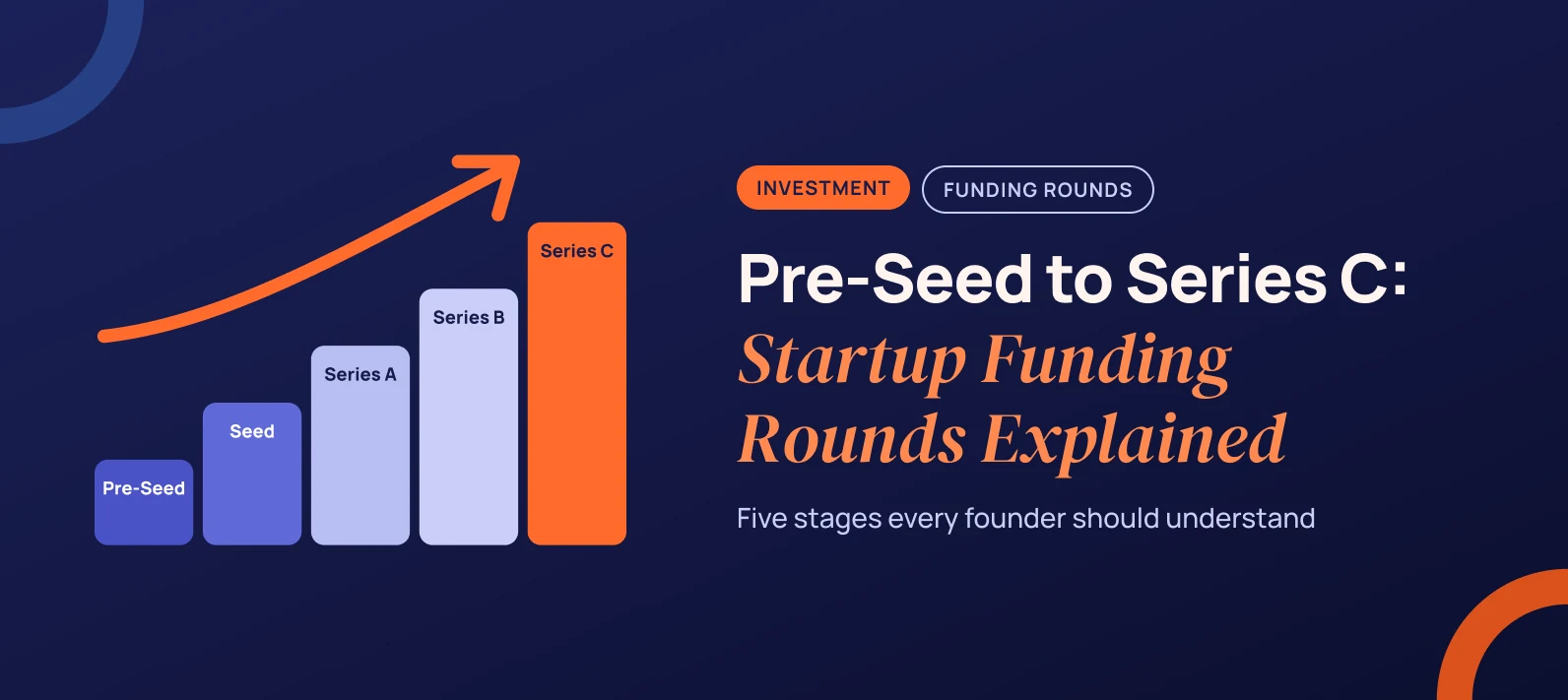
The five common startup funding rounds are Pre-Seed, Seed, Series A, Series B, and Series C.
- Pre-Seed: Validate the business idea and build an MVP.
- Seed: Acquire early customers and test product-market fit.
- Series A: Establish a repeatable and scalable business model.
- Series B: Expand established operations and market reach.
- Series C: Fund large-scale expansion, acquisitions, and strategic growth.
These stages describe how businesses mature. Startups are not required to raise every round or follow a fixed sequence.
What Are Startup Funding Rounds?
Startup funding rounds are financing events through which companies raise capital to achieve specific business milestones. Investors may receive ownership in the company or securities that convert into equity under agreed conditions.
Why not raise all the money at once?
Because the risks change as a startup grows. At Pre-Seed, investors evaluate whether an idea has potential. At Series A, they expect stronger evidence that the business can grow repeatedly. By Series C, investors are assessing whether a company can manage significantly larger investments.
The Indian market also reflects this emphasis on business readiness.
According to Inc42’s Indian Tech Startup Funding Report, Q3 2026, Indian startups raised $2.2 billion across 210 deals between July and September 2026. Funding increased 5% year-on-year, but deal count declined 13%.
More capital was deployed across fewer transactions. For founders, this reinforces the importance of demonstrating credible business progress when approaching investors.
Startup Funding Stages in India at a Glance
The following section compares the common startup funding stages in India, their purposes, indicative funding amounts, and investors.
1. Pre-Seed Funding
Objective: Validate an idea and build an MVP.
Indicative funding range: ₹5–₹50 lakh
Common investors: Founders, angel investors, and early backers.
2. Seed Funding
Objective: Acquire customers and validate demand.
Indicative funding range: ₹50 lakh–₹5 crore
Common investors: Angel investors, micro-VCs, and seed funds.
3. Series A Funding
Objective: Build a scalable business model.
Indicative funding range: ₹5–₹50 crore
Common investors: Venture capital firms.
4. Series B Funding
Objective: Expand established operations.
Indicative funding range: ₹50–₹200 crore
Common investors: Growth-stage VCs and strategic investors.
5. Series C Funding
Objective: Pursue large-scale growth.
Indicative funding range: ₹200 crore+
Common investors: Late-stage VCs, private equity firms, and institutional investors.
Source: Indicative ranges adapted from CorporateWalla’s Indian startup funding guide. These are advisory estimates, not official nationwide medians or fixed funding requirements. Actual investments vary substantially by sector and company.
What Happens at Each Startup Funding Stage?
1. Pre-Seed Funding: Can the Idea Become a Business?
Pre-seed funding helps founders turn an idea into a working product and establish whether there is a real market problem worth solving.
At this stage, a startup may have little or no revenue. Investors are primarily evaluating the founding team’s capabilities, market understanding, and ability to execute.
The capital typically supports customer research, prototype development, technical resources, and early hiring.
What do investors look for?
- A problem worth solving.
- A founding team capable of building the solution.
- Evidence of potential customer demand.
- A realistic plan to validate the product.
The objective is not necessarily to generate substantial revenue immediately. It is to establish whether the business has enough potential to justify further investment.
Indian startups can also explore eligible government and incubator-led support. The Startup India Seed Fund Scheme provides up to ₹20 lakh in grants for early validation and up to ₹50 lakh through debt or convertible instruments for commercialization. Its last advertised startup application deadline was May 31, 2026.
When should founders consider Seed funding?
When an initial product has been tested, and customer feedback supports further product development and market validation.
2. Seed Funding: Will Customers Actually Pay?
Seed funding helps startups refine their products, acquire customers, and establish whether demand can support a sustainable business.
A product may work perfectly, but that does not necessarily mean customers will pay for it.
Seed investors want evidence that the proposed solution addresses a real need.
They generally assess product usage, customer feedback, early revenue, retention, and the startup’s ability to acquire customers.
Founders should use Seed capital to answer three questions:
- Who is the ideal customer?
- Why do customers choose this product?
- Can the company acquire and retain more customers without unsustainable spending?
When is a startup ready for Series A?
When it can demonstrate meaningful traction and a credible plan to acquire customers repeatedly with improving unit economics.
3. Series A Funding: Can the Business Grow Repeatedly?
Series A funding helps startups turn early traction into a repeatable business model.
A few successful sales are encouraging. However, investors want to understand whether those results can be reproduced as the company grows.
Series A capital commonly supports sales, marketing, product development, technology, and team expansion.
What do Series A investors evaluate?
- Revenue growth and consistency.
- Customer acquisition cost (CAC).
- Customer lifetime value (LTV).
- Customer retention and repeat purchases.
- Gross margins and profitability potential.
CAC measures the cost of acquiring a customer. LTV estimates the value a customer contributes throughout the relationship. Together with retention and margins, these metrics help investors evaluate growth efficiency.
The expectation is not identical across industries. Deep-tech businesses, for example, may require substantial investment before commercial revenue becomes meaningful.
When should founders pursue Series B?
When they have demonstrated that their business model works consistently and additional capital can expand it efficiently.
4. Series B Funding: Can the Company Scale Without Losing Efficiency?
Series B funding supports businesses with an established growth model that need additional capital to expand operations.
Expansion creates new challenges. A company entering more cities needs stronger distribution, management, infrastructure, and financial controls. Growing revenue is valuable only when the business can manage the costs associated with it.
Series B investors assess revenue consistency, customer retention, unit economics, market expansion opportunities, and leadership capabilities.
Indian example: Comet’s ₹100 crore Series B
In September 2026, Indian footwear brand Comet raised ₹100 crore in Series B funding, led by Verlinvest, with participation from existing investors Elevation Capital and Nexus Venture Partners.
According to Business Standard, the company planned to use the capital for retail expansion and other growth initiatives.
The investment illustrates the role of Series B capital in expanding an established business, rather than testing whether its original product has demand.
5. Series C Funding: What Does the Company Need to Become a Market Leader?
Series C funding provides later-stage capital for established startups pursuing larger growth opportunities.
At this point, the business should have stronger evidence of its market position and commercial performance. Investors are evaluating whether substantial capital can generate additional long-term value.
Funding may support international expansion, acquisitions, product diversification, and stronger operational infrastructure.
What do Series C investors examine?
- Revenue scale and predictability.
- Profit margins and cash-flow performance.
- Customer retention and market position.
- Corporate governance and financial controls.
- Potential returns from expansion initiatives.
Indian example: DailyObjects’ ₹332 crore Series C
In October 2026, Indian lifestyle-tech brand DailyObjects raised approximately ₹332 crore in Series C funding, led by Xponentia Capital Partners, Anicut Capital, and Axiom Asia Private Capital.
According to Trilegal, the transaction combined fresh capital investment with secondary share sales.
The company intended to expand its retail presence, strengthen product development, and explore international markets.
This distinction is important. Primary funding brings new capital into the business, while secondary funding generally transfers ownership between investors or existing shareholders.
A ₹332 crore transaction does not necessarily mean the company receives the entire amount for operations.
How Do Startup Funding Rounds Affect Valuation and Ownership?
Every funding round can change who owns the company and how much control existing shareholders retain.
When startups issue new equity, existing shareholders may experience dilution. The company’s valuation can increase or decrease between rounds.
Two terms matter:
- Pre-money valuation: The company’s valuation before a new investment.
- Post-money valuation: The valuation after including the new investment.
Consider an Indian startup raising ₹2 crore at an ₹8 crore pre-money valuation.
Startup Valuation Breakdown
Pre-money valuation: ₹8 crore
New investment: ₹2 crore
Post-money valuation: ₹10 crore
New investor ownership: 20%
Existing shareholder ownership: 80%
How Does Another Funding Round Affect Ownership?
Now assume the company issues another 15% stake in its next round.
The original shareholders’ combined ownership falls from 80% to 68%, assuming no other changes.
This simplified calculation excludes employee stock option pools and outstanding convertible instruments.
The important consideration is not whether dilution can be avoided entirely. It is whether the investment creates enough additional value to justify the ownership being exchanged.
Which Funding Instruments Are Used in India?
Indian startups can raise equity using different securities and financing arrangements.
1. Equity Shares
Investors receive ownership in the company in exchange for providing capital.
2. Compulsorily Convertible Preference Shares (CCPS)
CCPS convert into equity shares under agreed terms and conditions.
3. Convertible Notes
Convertible notes are debt instruments that can convert into equity or be repaid under specified conditions.
4. iSAFE
iSAFE is an India-adapted early-stage investment structure that uses CCPS.
For example, 100X.VC’s iSAFE uses a CCPS-based structure.
Foreign investment also requires consideration of applicable regulations. The Reserve Bank of India’s foreign-investment directions specify a minimum of ₹25 lakh in a single tranche for eligible non-resident investment in Indian startup convertible notes, subject to relevant conditions.
Founders should understand conversion terms, liquidation preferences, voting rights, and other contractual obligations before accepting investment.
How Much Funding Should an Indian Startup Raise?
Raise enough to reach the next meaningful business milestone, not simply the maximum amount an investor is willing to offer.
The capital requirement should be based on operating expenses, planned investments, expected revenue, and a realistic runway.
A basic calculation is:
Funding required = (Monthly net burn × Target runway) + One-time costs + Contingency − Available cash
Consider an Indian SaaS startup:
- Monthly net burn: ₹8 lakh.
- Planned runway: 18 months.
- One-time costs: ₹20 lakh.
- Available cash: Assumed zero.
The estimated requirement is ₹1.64 crore before contingency.
The startup should then account for unexpected expenses, revenue changes, and fundraising delays.
The next question is whether this ₹1.64 crore can help the business achieve a measurable milestone.
Will it support a successful launch? Improve retention? Build repeatable revenue?
If founders cannot explain what the funding will accomplish, the amount alone does not establish a convincing investment case.
How Can Founders Identify the Right Funding Stage?
The right funding stage depends on what the startup has already proven and what it needs to achieve next.
1. Pre-Seed Funding
Business position: Idea with limited validation.
Funding stage to consider: Pre-Seed.
2. Seed Funding
Business position: MVP developed with early customer interest.
Funding stage to consider: Seed.
3. Series A Funding
Business position: Strong traction and repeatable growth potential.
Funding stage to consider: Series A.
4. Series B Funding
Business position: Established business model ready for expansion.
Funding stage to consider: Series B.
5. Series C Funding
Business position: Significant scale with major growth opportunities.
Funding stage to consider: Series C.
The company’s age is not the deciding factor.
A deep-tech startup may require a larger early-stage investment than a consumer business because product development and research costs differ.
Founders should identify the investment stage through business evidence, not an assumed funding timeline.
How Can Indian Startups Prepare for Their Next Funding Round?
Fundraising preparation starts before the investor meeting.
Founders should be able to explain what the company has achieved, what it needs next, and how the proposed investment will help.
Five areas require attention:
- Funding objective: Define the milestone the investment will support.
- Financial performance: Prepare reliable revenue, expense, cash-flow, and growth records.
- Pitch deck: Present the problem, solution, target market, business model, traction, and funding requirements.
- Investor selection: Identify investors whose sector knowledge, investment stage, and funding capacity align with the business.
- Due diligence: Organize incorporation documents, financial statements, shareholder agreements, intellectual property records, and capitalization tables.
Why Does Choosing the Right Investor Matter?
A higher valuation or larger investment does not automatically make an investor the best choice.
An investor with relevant industry experience may help a startup build commercial relationships, improve decision-making, and prepare for future funding.
In a Mr CEO fundraising discussion, Renil Komitla emphasizes the importance of investors who can contribute industry connections and guidance alongside capital.
Founders should evaluate the investor’s expectations, strategic fit, and proposed financing terms before deciding.
What Legal Requirements Should Indian Founders Consider?
Fundraising may involve obligations under the Companies Act, 2013, and, for applicable foreign investment transactions, FEMA and related rules.
Requirements depend on the company and financing instrument.
Founders should review securities issuance, valuation reports, shareholder approvals, filings, and contractual rights with qualified legal and financial professionals.
For government-backed support, refer to Startup India for current recognition requirements and available schemes.
What Common Fundraising Mistakes Should Founders Avoid?
Raising capital solves a financing requirement. It does not automatically solve weaknesses in the underlying business.
Founders should avoid:
- Raising without a defined goal: Capital must support measurable progress.
- Ignoring equity dilution: Understand how each round changes ownership.
- Overestimating revenue: Financial projections must be supported by realistic assumptions.
- Choosing investors only by valuation: Investor rights and strategic alignment matter.
- Starting fundraising too late: Limited runway can weaken negotiating power.
- Ignoring compliance: Incomplete documents and unsuitable financing structures can delay future rounds.
Choosing the Right Startup Funding Round in India
Startup funding rounds are not achievements to collect. They are financing decisions that should help a business solve its next growth challenge.
Before approaching investors, founders should know how much capital they need, what that capital will accomplish, and how the investment may affect ownership and control.
The amount raised may attract attention. What the company achieves with it determines the value of that investment.
FAQs on Startup Funding Rounds
1. What Is the Difference Between Pre-Seed and Seed Funding?
Pre-seed funding helps founders validate an idea and develop an early product. Seed funding focuses on acquiring customers and establishing whether the product can attract sustained demand.
2. How Many Funding Rounds Can an Indian Startup Have?
There is no fixed number. Startups may raise Pre-Seed, Seed, Series A, B, C, and subsequent rounds. Some skip stages, raise bridge financing, or avoid external equity altogether.
3. What Is Pre-Series A Funding in India?
Pre-Series A is an intermediate financing stage between Seed and Series A. Founders may use it to improve business traction and extend runway before seeking a larger institutional round.
4. Can an Indian Startup Raise Series A Without Revenue?
Yes. Some research-intensive or deep-tech startups can raise Series A based on technical progress and market potential. Requirements vary by sector and investor.
5. How Long Does It Take Between Funding Rounds?
There is no standard interval. The timing depends on business progress, cash runway, market conditions, and fundraising readiness.
6. What Is Bridge Funding?
Bridge funding provides interim capital before an anticipated funding round or business milestone. It can extend runway but may introduce additional repayment obligations or dilution.
7. Can Indian Startups Raise Funding Without Giving Up Equity?
Yes. Bootstrapping, grants, loans, and certain other financing arrangements can provide capital without selling ownership. Each comes with different eligibility, cost, or repayment considerations.