Table of Contents
- Cash in Bank vs. Recognized Revenue
- Revenue Recognition Basics: The Rules Startups Must Follow
- The "Founder’s Trap": Red Flags of Aggressive Accounting
- 3 Red Flags Every Investor Watches For
- The Long-Term Cost of “Top-Line Tweaking”
- The Mr CEO Way: Building a Transparent Revenue Model
- Revenue Recognition and Earnings Quality
- Conclusion: Transparency Is the Ultimate Competitive Advantage
- FAQs
A common trap in the startup ecosystem is the belief that Revenue = Growth. For a CEO, this assumption is dangerous. Revenue is not always cash; it is an accounting entry. It is an outcome shaped by timing, recognition principles, and standards. Understanding the "gap" between a signed contract and cash in the bank is what separates amateur founders from sophisticated CEOs.
Cash in Bank vs. Recognized Revenue
Cash is real. It improves your liquidity. It funds your and your staff’s salaries. It pays your suppliers and everything else that builds your startup.
You have to recognize that your revenue is different. It depends on timing rules and income recognition. A company might record revenue today for a product that won’t be delivered for six months. If the cash never arrives, you haven’t just lost a sale—you’ve inflated your earnings and created a “trust deficit” with your board.
Under modern accounting standards like IFRS 15 and ASC 606, companies must follow strict revenue recognition principles:
- Identify the contract
- Identify performance obligations
- Determine transaction price
- Allocate price to obligations
- Recognise revenue when the performance obligation is satisfied
In theory, this ensures clean financial reporting. In practice, gaps allow financial statement manipulation and even earnings inflation.
This is where revenue recognition risks begin.
Revenue Recognition Basics: The Rules Startups Must Follow
Startups focus on growth metrics. ARR. MRR. GMV. Bookings. But revenue recognition practices require discipline. Revenue should be recorded only when:
- A service is delivered
- A product is transferred
- Performance obligations are met
If a SaaS company receives a 12-month subscription upfront, it cannot recognize all revenue immediately. Doing so would be aggressive revenue recognition. It should spread over 12 months.
The "Founder’s Trap": Red Flags of Aggressive Accounting
Startups are often tempted by “aggressive” revenue recognition to hit valuation targets. However, investors are trained to spot these tactics:
- Booking Before Delivery: Recording a sale before the service is actually rendered.
- Channel Stuffing: This is a fraudulent tactic where companies force more product through a distribution channel than it can sell to inflate short-term numbers. (Warning: This is a major legal risk.)
- Front-loading Subscriptions: If a user pays for a year upfront, you cannot book it all in Month 1. It must be spread over 12 months.
Pro-Tip: If your accounts receivable are growing faster than your revenue, your “growth” is likely an accounting illusion. Investors will find this in the first 24 hours of due diligence.
3 Red Flags Every Investor Watches For
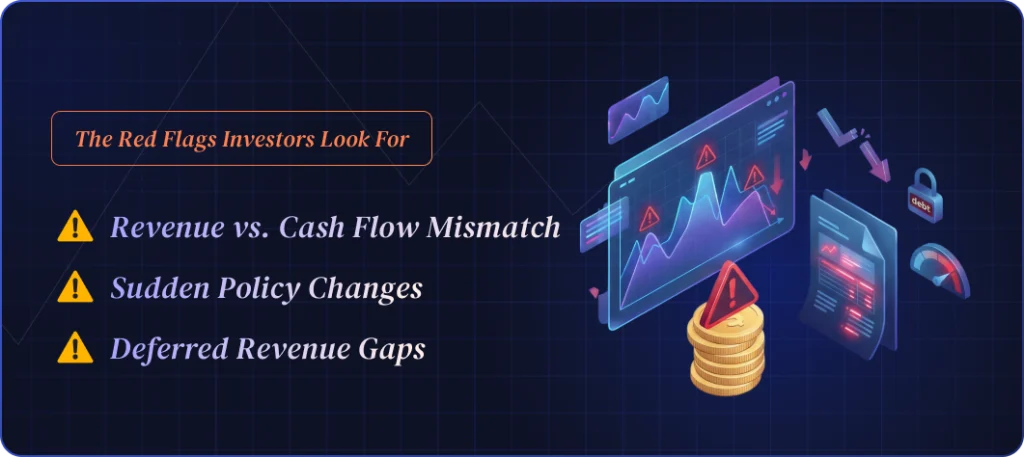
Smart investors do not chase growth blindly. They study revenue recognition and earnings quality as well.
- Revenue vs. Cash Flow Mismatch: If revenue rises sharply but cash flow remains weak, your “income” is fragile.
- Sudden Policy Changes: Frequent changes in how you recognize revenue signal that you are “smoothing” earnings to hide a slump.
- Deferred Revenue Gaps: Numbers between revenue growth and contract liabilities should align logically. If they don’t, the quality of your earnings is low.
Investors also compare revenue growth with deferred revenue and contract liabilities. Numbers should align logically.
The Long-Term Cost of “Top-Line Tweaking”
Manipulating the top line rarely survives an audit. While it might lead to a higher valuation today, the long-term costs are devastating:
Loss of Investor Confidence: Once trust is broken, you cannot get it back.
Valuation Multiples Collapse: Even minor manipulation can reduce your valuation multiples significantly when discovered.
Regulatory & Legal Scrutiny: History is full of founders who “tweaked” sales only to face total collapse (e.g., Wirecard).
History offers strong revenue recognition fraud examples. Companies that inflated sales eventually faced collapse. Financial misrepresentation will damage your brand equity. It destroys business valuation.
The impact of revenue recognition performance on business valuation is massive. Even small financial statement manipulation in earnings quality can reduce valuation multiples dramatically.
The impact of revenue recognition on business valuation can be dramatic. Even minor financial statement manipulation can reduce valuation multiples significantly.
This is why sophisticated investors prioritize financial performance evaluation over headline revenue growth.
The Mr CEO Way: Building a Transparent Revenue Model
Great leaders avoid aggressive revenue recognition. They build trust instead. At Mr CEO, we believe transparency is a competitive advantage. Great leaders focus on Unit Economics and Real Cash Conversion rather than vanity spikes.
A transparent model prioritizes:
- LTV (Lifetime Value) over Bookings: Sustainable growth is better than a one-time inflated hit.
- Audit-Ready Reporting: Clear earnings reporting improves investor confidence and attracts long-term capital.
- Structured Investment Research Analysis: Comparing revenue to operating cash flow and studying auditor remarks before they become a problem.
Revenue Recognition and Earnings Quality
Earnings quality reflects sustainability. High-quality earnings come from real demand. Not accounting for irregularities.
When revenue is recognized properly:
- Cash follows revenue
- Margins remain stable
- Growth compounds naturally
When revenue is manipulated:
- Cash lags
- Margins fluctuate
- Restatements occur
For serious business investment decisions, understanding revenue recognition principles is not optional. It is essential.
Conclusion: Transparency Is the Ultimate Competitive Advantage
In modern Business Investment, mastering Revenue Recognition is essential. Companies that follow sound revenue recognition principles build credibility and long-term value. Those relying on aggressive revenue recognition or financial statement manipulation may inflate numbers temporarily but risk permanent damage.
For investors, understanding Revenue Recognition is not just about accounting. It is about protecting capital, improving business investment analysis, and ensuring sustainable growth. Transparency is not optional. It is a strategy.
FAQs
- What is the main goal of Revenue Recognition in business investment?
It’s about making sure your revenue matches the work you’ve actually done. For a founder, it keeps your books honest so that when an investor looks at your growth, they see real progress, not just “paper gains” that will disappear during due diligence.
- Why do investors care so much about “Deferred Revenue”?
Think of deferred revenue as a “promise to perform.” It’s money you’ve collected but haven’t earned yet. Investors track this because it shows the health of your future pipeline. If deferred revenue is high, it signals that your customers trust you with their money upfront.
- What is the “5-Step Model”?
It’s the gold standard for honest accounting (ASC 606). It basically forces you to prove that a contract exists, define what you owe the customer, and only count the money as “revenue” once that customer has received exactly what they paid for.
- How does aggressive revenue recognition hurt my company’s valuation?
Investors don’t just pay for revenue; they pay for quality revenue. If they discover you’ve been booking sales too early (aggressive recognition), they will apply a “risk discount” to your entire company, significantly lowering your valuation multiples.
- Can I fix revenue recognition issues before raising capital?
Yes, and you should. Voluntarily restating your books to be more conservative before a fundraiser shows Founder Maturity. It tells investors you care more about long-term stability than short-term optics, which is a massive green flag for business investment.