
Table of Contents
- Why Does Measuring Product Market Fit (PMF) Matter?
- The Sean Ellis Test (The Gold Standard)
- How You Can Run & Interpret the Survey Accurately in 2026
- 5 Key Product Market Fit Metrics
- Frameworks to Identify and Measure PMF
- Tools to Track Product-Market Fit in 2026
- Common Mistakes Founders Make When Measuring PMF
- Real-World Examples
- Conclusion
Startups can witness a turning point by achieving a product that is a market fit. It is all about turning your best idea into a product that your customers need. You need clear signals and measurable proof. That’s why knowing how to measure product market fit is essential for every founder. It is necessary to understand the product-market fit, as it gives clarity about the utility, purpose, and success/failure of the product from the customer perspective. The right framework and metrics can help guide you on the right track or show you that you need to re-evaluate your efforts to refine product, messaging, etc. Stuck with this dilemmatic situation? This guide will be the perfect go-to reference. Simple yet effective and proven ways to measure product-market fit that you can use to confidently track your progress, make smarter decisions, and develop a product that becomes a habit for your consumer. In short, to make your product ace the competitive market.
Why Does Measuring Product Market Fit (PMF) Matter?
The only way to grow as a startup is to create a product that solves customer issues. Hence, measuring your product market fit is an essential step. It helps founders to understand whether their product is actually working or not and whether they are ready to scale or not.
The right product-market fit metrics can help startups to measure product-market fit accurately and make smarter, data-driven decisions. Here are some specifications that explain what you should consider when measuring the metrics:
Prevents Premature Scaling
Being eager for growth is good, but immature eagerness can cause trouble. PMF insights save you from committing that blunder and redirect your focus to real market needs.
Aligns Decision with User Satisfaction
PMF measurement acts like a mood meter. It shows what your customers like and what they do not. Using these insights, you can work on product development that will result in increased customer retention and enhanced user-product fit.
Supports Strong Startup Growth
Validating market fit clarifies demand, competition, and opportunities, while strengthening key startup metrics to ensure your startup growth is driven by real user behavior.
Boosts Investor Confidence
Once you know how to evaluate product market fit, you can deliver your pitch more convincingly. A solid product market fit framework shows evidence of traction and real market validation.
Creates a Foundation for Scaling
PMF is the best way to ensure that your product is in position with market needs, giving you a strong base for sustainable growth.
The Sean Ellis Test (The Gold Standard)
The Sean Ellis Test, known as the gold standard for measuring product-market fit, starts with a single key question:
“How would you feel if you could no longer use this product? ”
If at least 40% of users say they would be “very disappointed,” it strongly indicates product-market fit. This test fits inside any pragmatic product market fit framework. Also, it has been widely used as a core product market fit metric.
How You Can Run & Interpret the Survey Accurately in 2026
- Ask the core Question First:
Use canonical options like Very Disappointed/Somewhat disappointed/Not disappointed/I don’t use it any longer. This preserves comparability with historical PMF data and product market fit examples.
- Survey the Right Cohort:
Connect with your recent users and understand its core quality. Try to avoid the churned or casual users, as it will reduce noise in PMF measurement.
- Use Modern Channels and Microsurveys:
You can combine emails, product-intercept prompts, or in-app microsurveys. It will boost the response rates and reduce selection bias. A quick survey on mobile is helpful.
- Sample Size & Statistical Rigor:
Aim for a stable sample size, typically 100–400 respondents per cohort. Track the score over time rather than relying on just one survey, and evaluate results based on established standards.
How does this tie to “How to Evaluate Product Market Fit”
You can use the Sean Ellis Test as your quantitative north star. Simply combine it with retention cohorts, NPS, and qualitative reasons to create a robust product-market validation system.
5 Key Product Market Fit Metrics
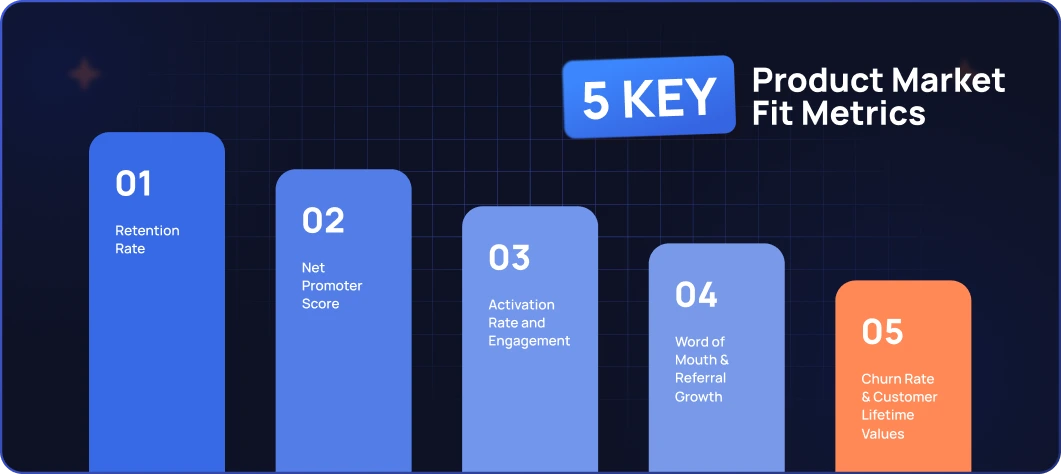
Initially, you need to understand how to measure product market fit, as it helps you track the right numbers. These PMF metrics provide real user behavior, validate market fit, and showcase whether our product is ready for scale. Let’s go through some of the product market fit metrics:
- Retention Rate:
The go-to metric is Retention rate to evaluate the product-market fit. A strong rate of customer retention indicates that your product is satisfactory. The high retention rate indicates that you have good customer retention that supports startup growth and improves long-term revenue. Strong retention is often seen in products with a clear user-product fit.
- NPS (Net Promoter Score):
NPS is used for measuring customer satisfaction and loyalty. A high NPS indicates strong trust, positive sentiment, and organic evangelism. This is an ideal way for testing market demand and further referral-driven growth.
- Activation Rate & Engagement:
Want to check if your customer reaches that ‘aha moment’ for your product? Activation can help you detect it, while engagement confirms how often and how much they rely on your products. Both metrics quantify early value delivery, which is critical for product development, and quantify product success.
- Word of Mouth & Referral Growth:
Genuine referrals from existing users drive true product-market validation. Recommendations reflect emotional adoption, high trust, and strong market validation. These factors boost key start-up metrics and enable low-cost customer acquisition.
- Churn Rate & Customer Lifetime Values (CLV):
Slow churn rates and rising CLV reflect long-term satisfaction, stable revenue, and sustainable market validation. They are essential metrics for evaluating product-market fit and scalability.
Frameworks to Identify and Measure PMF
Here are some reliable frameworks that make it easier to understand whether your product is meeting real user goals or not:
The Lean Product Process (by Dan Olsen)
- It helps you identify your target customer clearly.
- Encourages validating real customer needs before building.
- Helps you focus on shaping a strong value proposition.
- Simple and small experiments are used with quick feedback loops.
- Supports continuous improvement based on real user input.
The Product-Market Fit Pyramid
- Breaks PMF into five layers for clarity.
- Helps define your ideal customer and their underserved needs.
- Connect your value proposition directly to features.
- Ensures the user experience supports your core value.
- Easily spot gaps between what users need and what you offer.
The AARRR Metrics Framework (Pirate Metrics)
- You can track user flow through Acquisition, Activation, Retention, Revenue, and Referral.
- Shows how users discover and interact with your product.
- Highlights engagement patterns and long-term behavior.
- Helps measure customer loyalty and referral strength.
- Provides a simple structure to understand overall traction.
Tools to Track Product-Market Fit in 2026
Here are some of the useful tools that will help your teams to understand user behavior, analyze PMF metrics, and improve overall product-market alignment:
Mixpanel, Amplitude & Hotjar (Behavior Tracking)
- This tracks user actions, engagement, and feature usage in real time.
- You can identify patterns that support strong PMF metrics.
- Reveal friction points that affect retention and user-product fit.
- You get behavior heatmaps and funnels to study product market fit examples.
- Help teams refine product development based on actual user behavior.
Typeform / Google Forms (PMF Surveys)
- This is ideal for running the Sean Ellis “very disappointed” survey.
- Simple to create and distribute measuring customer satisfaction surveys.
- It enables segmentation to understand different user groups.
- It provides clean, structured insights for PMF measurement.
- Perfect for gathering qualitative feedback to improve product-market alignment.
AI-Based Analytics Tools (Predictive Retention Insights)
- You can use machine learning to forecast retention and churn.
- It highlights at-risk users early for better customer retention.
- This can predict which features drive long-term value.
- Offer automated insights that support market validation.
- Help quantify product success with deeper, future-focused analysis.
Common Mistakes Founders Make When Measuring PMF
Here are some frequent pitfalls that you have to avoid, as they can make PMF measurement unclear or misleading:
Misreading Vanity Metrics (Traffic ≠ PMF)
- High traffic or sign-ups can look good but may not reflect real value.
- Vanity numbers often hide weak retention or low engagement, which is a clear sign of unclear data.
- PMF becomes visible only when behavior supports strong PMF metrics.
Ignoring Qualitative Feedback
- Numbers show what users do, but not why they do it. Hence, focus is essential.
- Also, skipping interviews leads to missed insights on user-product fit.
- Qualitative input often reveals product-market alignment gaps early.
Focusing Only on Growth, Not Value Delivery
- Rapid expansion without validated value leads to high churn.
- Growth should follow—not replace—clear market validation.
- Sustainable success comes from solving real user problems consistently.
Real-World Examples
Here are a few brands that showcase the best examples and learning experiences. These brands show how strong alignment and customer understanding lead to lasting traction:
Dropbox’s Referral Loop
- Leveraged simple referrals to drive low-cost growth.
- Strong engagement proved real value and user-driven expansion.
Slack’s “Workplace Habit” Retention Metric
- Measured daily active usage as a sign of becoming essential.
- High retention highlighted deep product-market alignment.
Notion’s Word-of-Mouth Expansion
- Grew organically through community love and shared templates.
- Demonstrated powerful ability to measure customer satisfaction through advocacy.
Conclusion
It is essential to understand how to measure product market fit. It is more than a checklist. It is the difference between building a product that survives and one that truly thrives. You have to track the right signals, listen to real users, and refine continuously. This is the only key to unlock clarity, confidence, and direction. Keep questioning, keep measuring, and keep improving. It is because mastering how to measure product market fit is ultimately what shapes lasting success in any market.