
Table of Contents
In a startup, finding a great product is only half the battle. Most of them fail not because of innovation but because they struggle with go-to-market challenges. This means reaching the right customers, with the right message, at the right time.
But why is the GTM (Go to Market) strategy essential? It defines:
- how a startup enters the market
- positions its value
- understands product-market fit
- prices it’s offering,
- converts demand into revenue
Although GTM planning appears straightforward on paper, execution is where most startups fail.
This blog is a comprehensive guide that explains the most common go-to-market challenges for startups. We’ll explore why they happen and how to overcome go-to-market challenges in startups using proven, data-backed strategies. These insights are particularly relevant for SaaS and enterprise-focused startups navigating competitive markets.
Why GTM Challenges Matter for Startups

GTM challenges directly impact a startup’s survival and growth trajectory:
- Delayed market entry due to unclear positioning or compliance hurdles
- Slower time-to-revenue caused by long sales cycles and onboarding friction
- Wasted resources from poor customer segmentation and targeting
Several analyses of startup failures consistently show that poor market demand and weak distribution are among the most critical startup go-to-market challenges.
This is why even strong products struggle to gain traction when GTM execution is misaligned.
Hence, it’s critical to gather early customer insights, validation, and iterations. Without these details, building a sales and marketing motion on assumptions rather than evidence becomes a significant risk.
The Most Common GTM Challenges Startups Face
The top go-to-market challenges for early-stage startups typically appear during market entry and scaling phases. Understanding for whom the product is built and how to achieve product-market fit remains the core challenge.
Let’s examine the eight most critical obstacles:
1.Misunderstanding The Target Customer
If you’re unaware of whom you’re selling to, your entire startup strategy fails. An undefined or overly broad Ideal Customer Profile (ICP) is one of the most common go-to-market challenges.
Why this happens:
- Founders rely on intuition, not data
- Limited customer interviews or discovery
- Targeting “everyone” instead of a focused segment
Impact: Marketing messages fail to resonate, sales cycles drag, and churn increases.
Example: A SaaS startup selling workflow software initially targets SMBs, but ultimately discovers that regulated industries show the highest urgency and willingness to pay.
2.Weak Product Positioning and Messaging
Messaging must be precise. Poor positioning occurs when your messaging focuses on features, not outcomes.
Why this happens:
- Value propositions are unclear
- Messaging is overly technical
- Buyers struggle to differentiate the product from competitors
Impact: This is one of the most overlooked startup GTM hurdles, especially for technical founders who struggle to translate features into business value.
3.Pricing Model Complexity
Pricing confusion is one of the most frequent obstacles in any SaaS go-to-market strategy.
Why this happens:
- Overly complex pricing models
- Pricing that feels too cheap to signal value
- Misalignment between pricing structure and buyer expectations
Impact: Confusion between usage-based, seat-based, or hybrid pricing can slow adoption and revenue growth, particularly for go-to-market challenges for SaaS startups in 2026.
4.Long and Complex Sales Cycles
This challenge is amplified in enterprise go-to-market challenges.
Why this happens:
- Multiple stakeholders involved
- Procurement and compliance delays
- No clearly defined sales process
Impact: Deals stall and forecasting becomes unreliable without a mapped buyer journey. This is especially critical when selling to enterprise customers who require extensive validation.
5.Lack of Brand Credibility
Early-stage startups often lack:
- Case studies
- Testimonials
- Recognizable customer logos
Impact: Trust gaps make selling to mid-market and enterprise buyers harder, even if your product delivers real value. This credibility deficit is a significant barrier in enterprise sales.
6.Poor Onboarding and User Activation
Many startups acquire users but fail to activate them.
- Failure to help users reach the “aha” moment
- High drop-offs after signup or pilot
- Manual, confusing onboarding flows
Impact: This onboarding friction is a critical go-to-market challenge for SaaS startups in 2026, where buyers expect fast time-to-value. Poor sales & onboarding automation directly impact retention.
7.Inconsistent Lead Pipeline
An unpredictable pipeline is a major blockage to scale.
Why this happens:
- Over-reliance on founder-led sales
- Inbound-only strategies without outbound support
- No clear MQL to SQL handoff in pipeline management
Impact: Without a repeatable demand engine and proper sales funnel optimization, startup growth remains fragile.
8.Operational Complexity as You Scale
As startups grow, their operational inefficiencies surface:
Why this happens:
- Support overload
- Billing and compliance delays
- Manual onboarding and reporting
Impact: These backend issues quietly slow GTM execution and strain teams, preventing effective GTM strategy implementation.
How to Overcome GTM Challenges: Proven Strategies
Here are proven strategies to overcome these challenges:
1.Build a Clear, Data-Driven ICP
Actions:
- Conduct structured customer interviews
- Analyze deal data and churn patterns
- Prioritize segments with the highest urgency and lifetime value
Outcome: Focus beats scale in early GTM execution. Proper customer segmentation eliminates wasted marketing spend.
2.Strengthen Product Positioning
Actions:
- Lead with customer problems, not features
- Clearly articulate outcomes and ROI
- Define your competitive edge in one sentence
Outcome: Strong positioning simplifies enterprise sales and accelerates trust.
3.Simplify Pricing and Packaging
Actions:
- Use transparent, predictable pricing
- Align pricing with how customers perceive value
- Test pricing with early adopters before scaling to market
Outcome: Clear pricing reduces friction in the sales funnel optimization process.
4.Streamline the Sales Process
Actions:
- Map each stage of the buyer journey
- Align sales and marketing messaging upfront
- Create repeatable demo and pilot frameworks
Outcome: Predictability is the foundation of every successful GTM strategy and addresses common go-to-market challenges.
5.Build Credibility Early
Actions:
- Secure reference customers
- Publish short, outcome-focused case studies
- Use mid-market wins to move upmarket
Outcome: Social proof reduces friction in enterprise go-to-market challenges, particularly when selling to enterprise customers.
6.Fix Onboarding and Activation
Actions:
- Reduce steps to the first value
- Use guided walkthroughs and in-app education
- Automate onboarding where possible
Outcome: Faster activation improves retention and expansion, directly addressing onboarding friction.
7.Build a Consistent Lead Pipeline
Actions:
- Combine inbound and outbound channels
- Invest in SEO, content, channel partnerships for GTM, and targeted outreach
- Define clear MQL to SQL workflows
Outcome: A consistent pipeline enables predictable revenue, confident forecasting, and scalable growth beyond founder-led sales.
8.Reduce Operational Complexity with Automation
Actions:
- Automate support, billing, and onboarding
- Invest in scalable backend systems
- Eliminate manual dependencies early
Outcome: Operational clarity enables faster GTM execution and better sales & onboarding automation.
Bonus: A 60-Day GTM Improvement Plan for Startups
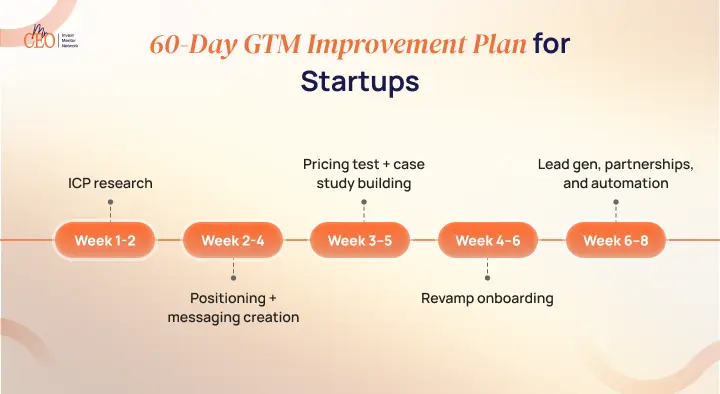
Weeks 1–2: Conduct ICP research and customer interviews
Weeks 3–4: Complete positioning and messaging refinement
Weeks 5–6: Execute pricing validation and case study creation
Weeks 7–8: Implement onboarding and activation improvements
Ongoing: Align lead generation, channel partnerships for GTM, and automation infrastructure
Real Examples of GTM Turnarounds
- A SaaS startup reduced churn by 30% after narrowing its ICP and improving customer segmentation
- An enterprise-focused company cut sales cycles by 40% by standardizing pilots and addressing compliance and regulatory delays
- A B2B platform doubled conversion rates by simplifying pricing model complexity
Each turnaround followed the same principle: fix startup GTM hurdles before scaling growth.
Conclusion: Building a GTM System that Scales
Every startup faces go-to-market challenges. From unclear positioning and pricing model complexity to long sales cycles and onboarding friction, these obstacles can determine success or failure. The discipline to identify GTM challenges early and fix them systematically separates thriving startups from those that churn.
GTM is not a one-time launch task. It must evolve with customer feedback, market dynamics, and scale. Until you treat GTM strategy as a living system—one you measure, test, and refine continuously—building sustainable startup growth becomes nearly impossible.
So ask yourself honestly: Are you scaling your startup, or are you scaling unresolved go-to-market challenges?
FAQs
1) What metrics define a successful GTM strategy?
Key GTM success metrics include:
- Customer acquisition cost (CAC)
- Conversion rates by channel
- Sales cycle length
- Activation and time-to-value
- Retention and churn
- Revenue per customer
2) What are the top go-to-market challenges for early-stage startups?
The top go-to-market challenges for early-stage startups include undefined customer segmentation (unclear ICP), weak product positioning, pricing model complexity, lack of brand credibility, inconsistent lead pipelines, and over-reliance on founder-led sales.
3) Why do startups fail at go-to-market execution?
Startups fail at go-to-market execution because they build strategies on assumptions rather than validated insights. Common failures include targeting too broad an audience, leading with features instead of outcomes, and underestimating enterprise go-to-market challenges like compliance requirements and multi-stakeholder decisions. They also lack sales funnel optimization and fail to automate key processes.
4) When do you need a GTM strategy?
You need a GTM strategy when:
- Launching a new product or service
- Entering a new market or geography
- Repositioning an existing offering
- Targeting a new customer segment
- Struggling with low conversions despite traffic or leads
5) How to overcome go-to-market challenges in startups with limited resources?
To overcome go-to-market challenges in startups with limited resources, focus on three priorities: narrow your ICP to high-urgency segments, leverage sales & onboarding automation to reduce manual work, and build credibility with 2-3 reference customers.