Table of Contents
- Understanding Bootstrapping
- Instances of Famous Bootstrapped Successes
- Grasping Venture Capital
- How VC Investment Works
- Who Are VC Investors?
- Market Trends Global VC Funding Trends in 2025
- Key Takeaways
- Pros and Cons of Bootstrapping
- Pros and Cons of Venture Capital
- Key Considerations for Choosing
- Which Path Is Right for You?
- Can You Mix Both?
- Conclusion
- FAQs
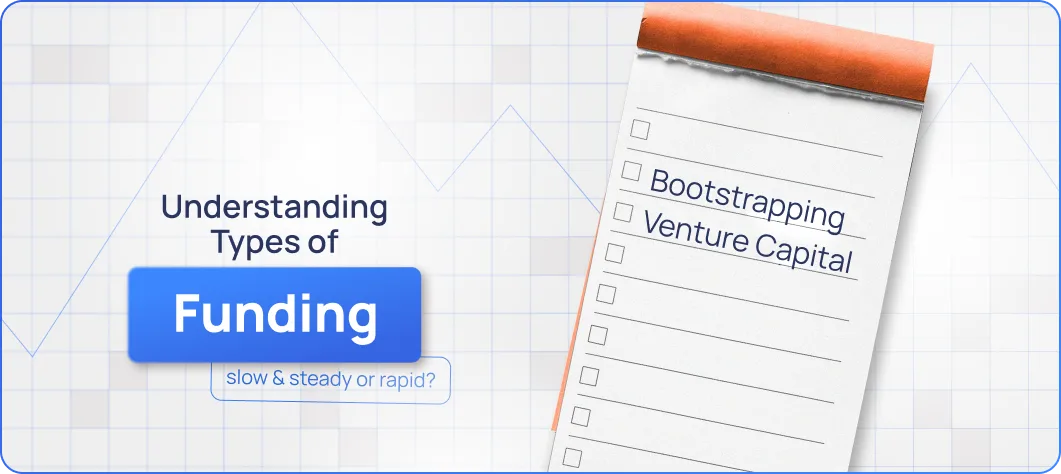
Every entrepreneur faces one of the most important business decisions early on: How will I fund my startup? The answer often comes down to two main routes—bootstrapping vs VC Funding. Both offer unique benefits and challenges, and the choice can influence everything from company culture and speed of growth to control by the founder, even the long-term exit strategy. Considering a trillion-dollar global startup landscape, funding decisions are much more crucial than ever. While venture capital fundings have been hitting hundreds of billions annually in the last years, bootstrapped startups still manage to produce long-term successes, testifying that money is not the sole criterion for a successful business. Wise financing choices can either mark sustained and founder-driven growth or fast-track growth backed by outside funding.
Understanding Bootstrapping
Definition and Explanation
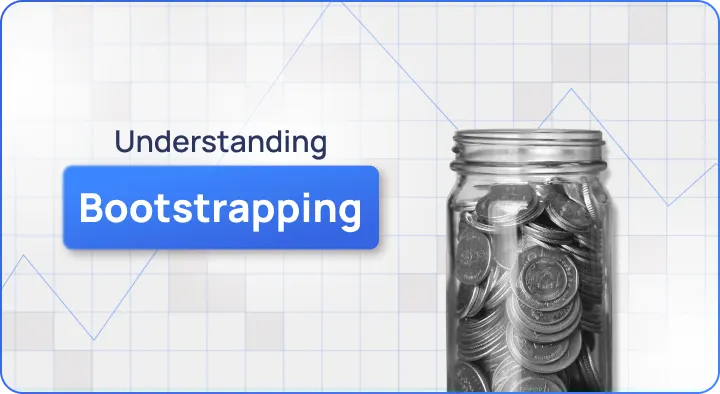
Bootstrapping refers to using personal savings, credit, or reinvesting profits to fund the business without outside investors. The founder retains 100% ownership and decision-making authority. This method is very popular for business startups in industries that require comparatively less capital.
How Bootstrapped Startups Operate
These companies grow organically, often starting small, focusing on market research startup tactics, and reinvesting early profits to expand. A bootstrapped business may begin as a side project until it generates enough revenue to support full-time operations.
Instances of Famous Bootstrapped Successes
Here are some famous bootstrapped success stories:
- Mailchimp: Has grown as a $12B acquisition target without ever having taken VC money.
- Basecamp: Has been profitable and independent for decades.
- Spanx: Founded by Sara Blakely with $5,000 in savings to create a billion-dollar brand.
- GoPro: It was an entirely personal credit card-funded venture before going public.
Clearly, the above examples show that sometimes the best startup funding does not come from outside the company; instead, the owners themselves invest and make it work.
Grasping Venture Capital
Definition and Explanation
Venture capital, or VC for short, is a way of startup funding wherein investors provide very large amounts of money in exchange for equity. VC firms look for startup companies with high growth potential in which to invest and exit with sizeable money returns through IPOs or acquisitions.
How VC Investment Works
- Seed Funding: Early capital for development and market testing.
- Series A/B/C: Bigger rounds aiming to fund operations and people development and establish new markets.
- Growth Funding: Investment at the highest level with the goal of market dominance, typically in technology startups or capital-intensive industries.
Who Are VC Investors?
- Venture Capital Firms: Institutional investors with large amounts of capital and funds.
- Angel Investors: High-net-worth individuals deploying private money at early stages.
- Private Equity Firms: Usually, they invest later, but sometimes get into high-growth startups.
Market Trends Global VC Funding Trends in 2025
Huge aggregate growth:
Global VC investing in the first half of 2025 totaled about $310–$314 billion. Close to 53% of this went into AI ventures, which is the highest percentage of any category.
AI dominates:
AI startups accounted for about 53% of total global VC dollars in H1 2025, and an even greater 64% in the U.S.
Q2 sector breakdown:
- In Q2 2025, AI accounted for about 45% of global VC funding.
- Healthcare & biotech was the second-largest sector with $14.8 billion.
- Fintech was third at $10.8 billion.
Summary: Sector-wise VC Money Share in H1 2025
- Sector Approx. VC Funding Share
- AI/AI-powered ventures ~53% globally and ~64% in the U.S.
- Healthcare & Biotech: Second-largest in Q2 (~$14.8B)
- Fintech Third-largest in Q2 (~$10.8B globally)
- Others (SaaS, etc.) Smaller shares compared to AI dominance
Key Takeaways
AI is the resounding champion in 2025 VC funding, eclipsing even high-growth segments such as fintech, biotech, and SaaS.
Healthcare/biotech and fintech are close runner-ups, but lag far behind AI in fund volume.
SaaS—formerly a reigning priority—currently takes a secondary role, with investor interest squarely focused on AI innovation.
Example of a VC-Backed Success
- Airbnb: Small-scale rental operations to a global hospitality brand with billions in valuation, powered through multiple VC rounds.
- Stripe: a collection of more than $2 billion in venture capital to promote its global growth.
Pros and Cons of Bootstrapping
The pros and cons of bootstrapping can be summarized as follows:
Pros:
- Founder Control: Strategic decisions remain without outside influence.
- No Equity Dilution: 100% of shares remain paid up to founders.
- Financial Discipline: Operating profit and ascendant.
- Flexible Decision-Making: No deadlines or milestones are imposed by investors.
Cons:
- Limited Growth Funding: Scaling up may be slower due to a lack of heavy budgets.
- Personal Risk: The founder has his/her own money on the line.
- Slower Market Entry: May find it difficult to compete against a heavily funded opponent.
- Limited Resources for Expanding: market studies, great launch strategies, etc.
Pros and Cons of Venture Capital
Pros and cons of Venture Capital:
Pros:
- Access to Large Capita: Good Capital Directory to Scale and Globalize.
- Mentorship & Networks: Receive strategic advice and industry contacts.
- Credibility: Being VC-backed attracts talent, customers, and partners.
- Faster Market Entry: With resources, this can block fast capture of market share by competitors.
Cons:
- Equity Dilution: Founders share a certain percentage of their ownership in exchange for funding.
- Shared Decision-Making: Investors may participate in key business decisions to support strategic growth.
- High Growth Expectations: Investors might have high growth pressure, aiming for scalability and timely returns.
- Structured Fundraising Process: Requires careful evaluations and discussions to ensure alignment and transparency.
Key Considerations for Choosing
Before deciding between bootstrapping vs. VC, ask:
- Type of Business: Are you an idea in the validation stage, or is this a proven product in the scaling stage?
- Capital Requirements: How much startup financing is needed for the next 12–24 months?
- Industry Type: In case the high-growth sector requires venture capital funds, smaller niche businesses grow on their own.
Long-Term Vision: Would you rather have a slow, continued growth or a fast exit?
Scenario 1 – Bootstrapping Fit:
A founder of a B2B SaaS tool with strong early adoption may bootstrap to profitability before seeking growth funding.
Scenario 2 – VC Fit:
A tech startup in the AI sector that needs rapid R&D may seek VC investment from day one.
Which Path Is Right for You?
Match your choice to your business startup funding strategy and personal goals:
- If retaining founder control is essential, lean toward bootstrapping.
- If capturing a fast-moving market matters most, then venture funding is perhaps what really counts.
Can You Mix Both?
Many founders resort to hybrid approaches:
- Bootstrap First: Build an MVP, get some customers, and start proving some traction.
- And Then Go VC: Once revenue builds and the metrics are strong, then one should appraise the company for funding to kick in the big growth acceleration.
Example:
- GitHub: For several years, it was bootstrapped, and then VC money was taken for global expansion.
- WhatsApp: Was lean until they got venture money for scaling.
Pros:
- The investor terms are fair enough for having a great track record.
- One should possess a higher ownership stake than what is usually left after an initial infusion from venture capitalists.
Cons:
- Hard to accept investor oversight.
- Timing is critical. If you’re coming in too late, competitors might have taken over.
Conclusion
Choosing between the two ways of funding your venture, bootstrapping vs. VC money, is not a matter of which is universally “better.” It all depends on your startup capital requirements, growth aspirations, and personal values. The bootstrapped path leads to independence and financial discipline, but at a very slow pace of scalability. With venture capital, firms are injected with business startup funding for achieving fast growth, but this will result in losing equity and control.
The smartest entrepreneur makes funding decisions based on the particular goal his business aims to achieve and the market realities affecting it. Whether you stay lean, seek big backing, or pick a little bit of both, remember: the best startup investments that count are investments in your vision for the long term, not your next funding round.
FAQs
1. What is the primary distinction between bootstrapping and venture capital financing?
Bootstrapping involves financing your company with your own savings or profits without outside investors. Venture capital financing consists of raising capital from investors in return for ownership stakes and frequently strategic participation.
2. Is bootstrapping superior to VC money?
Neither is always superior. Bootstrapping provides total ownership and control but may hinder growth. VC funding speeds scaling but with equity dilution and joint decision-making.
3.When should a startup plan for venture capital funding?
High-growth startups in industries such as AI, fintech, or biotech that need huge investment for scaling or R&D should plan for VC funding early.
4. Can a firm do both bootstrapping and VC funding?
Yes, most successful firms follow a hybrid approach. They bootstrap to achieve traction initially and then raise venture capital to scale later when metrics and revenue support investment.
5. What are the factors that I should weigh up before making the choice between bootstrapping and VC?
Capital needs, industry category, pace of growth, risk tolerance, and long-term perspective—whether you want to be independent or capture the market quickly—are among the critical considerations.