Table of Contents
- Why does early-stage funding matter so much for startups?
- What is early stage funding for a startup?
- Key Differences from Later-Stage Funding
- Types of Startup Funding for New Businesses in 2026
- Preparing for Startup Fundraising: What Investors Expect
- How to Raise Startup Funding Step-by-Step
- Conclusion & Founder Advice for 2026
- FAQs
The journey of turning a brilliant idea into a successful business requires more than just passion—it requires fuel. For new business founders, that fuel is early-stage funding. Early stage funding for a startup is make-or-break. This guide is your map for navigating the landscape of raising capital in the crucial, often tumultuous, initial phase of your company. Because it is the lifeline that allows you to build your Minimum Viable Product (MVP), achieve initial market validation, and scale your team. Without it, even the most innovative concepts often stall.
What’s New in 2026
- Investors are more selective, focusing on traction and real business models.
- Strong unit economics and efficiency.
- A clear pitch deck, data-driven, and outcome-focused.
- AI-driven fundraising tools are helping founders match with investors faster.
- Due diligence is becoming smoother and more automated through digital platforms.
Early-stage funding for a startup refers to the capital a company raises from inception up to the point where it establishes a strong market presence and repeatable revenue stream. This stage is high-risk but essential for turning an idea into a viable business.
It’s important to understand the typical funding nomenclature:
PreSeed Funding: This is the earliest money, often coming from friends, family, and your own pocket (bootstrapping). It’s used to test the idea, build a basic prototype, and validate the core hypothesis.
Seed Funding: The funds used to plant the “seed.” This capital is for achieving Product-Market Fit (PMF), expanding the team, and developing a product. A first significant round where external, professional investors like angel investors or venture capital firms get involved.
Series A Funding: This round is raised once PMF is proven. The capital is used to standardize the business model, scale operations, and expand market share. Investors at this stage are looking for clear metrics that demonstrate the potential for massive growth.
- Early-stage funding is valued based on potential, team quality & market size.
- Later-stage funding relies on proven revenue, traction & growth metrics.
- Early rounds are usually more founder-friendly in terms and equity.
- Due diligence at the early stage focuses heavily on vision, capability & execution potential.
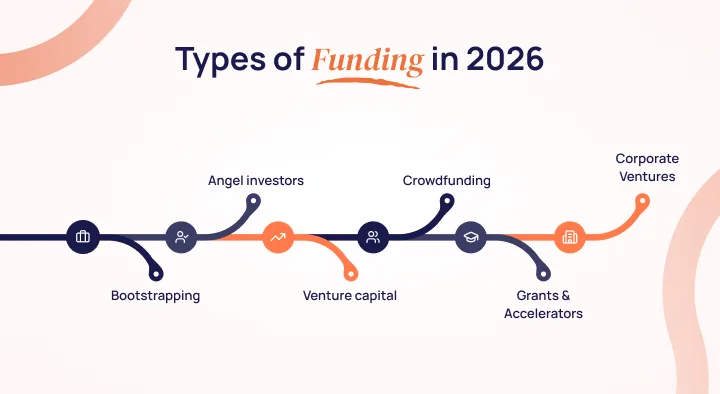
The methods for raising capital have never been more diverse. While startup fundraising remains challenging, founders have multiple avenues to explore.
Bootstrapping
This involves funding the new business solely through personal savings, early revenues, or credit. It’s the ultimate form of founder control and discipline. While it is not a large outside investment, it is often the first stage and shows investors you are deeply committed.
Angel Investors
Angel investors are high-net-worth individuals who invest their money, often taking a hands-on mentorship role. They typically participate in the pre-seed vs. seed funding stages and are looking for a strong team and a compelling vision. They are often more flexible and faster to close a deal than large firms.
Venture Capital (VC) Firms
VC firms invest institutional money for significant equity stakes. They are primarily focused on disruptive companies with high growth potential and often lead seed funding for startups and Series A rounds. The best venture capital firms bring more than money; they bring strategic guidance and vast networks.
Crowdfunding & Equity Crowdfunding for startups
Crowdfunding for a startup lets many people invest small amounts to support a startup. It has evolved into a reliable fundraising option. Equity crowdfunding gives contributors actual shares in the company and is now regulated, making it a strong way to build early interest and raise capital from the public.
Grants, Accelerators, and Incubators
Nondilutive funding, such as government or corporate grants, provides money without giving up equity. Accelerators and incubators offer seed capital, mentorship, and a structured program in exchange for a small equity stake, helping companies rapidly prepare for the next round of business funding.
Corporate Ventures & Partnerships
Large corporations often have venture arms (CVCs) that invest in startups that complement their business. These can offer strategic advantages, distribution channels, and an eventual exit path.
Entering the market to raise money unprepared is a recipe for failure. The process is a marathon, and preparation is key.
Have a Solid Business Idea
Your idea must solve a genuine, sizable problem. Investors want to see that you’ve done your homework, that your Total Addressable Market (TAM) is large, and that your solution is defensible. This foundational step is critical for any startup funding.
Show Some Traction
In 2026, traction is king. Investors want proof of concept, not just promises. This can include:
- Early customer adoption and engagement metrics.
- Initial revenue (even small amounts).
- Signed Letters of Intent (LOIs) or partnerships.
- A strong, positive growth rate in user acquisition or retention.
Create a Simple, Compelling Pitch Deck
Your pitch deck is your primary visual aid.
Include these key slides:
- Problem
- Solution
- Market Size
- Product
- Business Model
- Team
- Financials or Traction
- Competition
- Funding Request
- Vision
Keep it simple, clear, and story-driven. A great deck opens the door to your next investor conversation.
Legal Structure & Compliance Basics
Before taking money, make sure your company is legally structured and documented. This includes:
- Incorporating your company (typically as a C-Corp or similar entity).
- Securing all Intellectual Property (IP) and patents.
- Having clear founders’ agreements, vesting schedules, and cap table management.
- Ensuring basic regulatory compliance relevant to your industry.
Once prepared, the execution phase requires precision, persistence, and excellent relationship management.
Identifying the Right Investors
Don’t rely on cold pitches. Research investors, angel investors, and venture capital firms. Look at their portfolio, thesis, and sector focus to align with your startup funding needs. Use tools and platforms to filter investors by:
- Stage Focus: Do they invest in pre-seed vs. seed funding?
- Sector Focus: Do they understand your niche (FinTech, AI, HealthTech)?
- Check Size: Can they write the size of the check you’re raising?
Networking Strategies
Fundraising is a relationship game. Your best bet is always a warm introduction.
- Leverage Existing Networks: Ask your advisors, current investors, and industry contacts for introductions.
- Attend Key Events: Be present at relevant industry conferences and startup investment community events.
- Online Communities: Engage professionally on platforms where investors are active.
Perfect your pitch & storytelling
The pitch is not just about data; it’s about inspiration.
- Storytelling: Start with a compelling narrative about the problem and your personal conviction.
- Market Fit: Spend the most time proving your product-market fit (even early signs) with clear metrics. Investors want to know why now is the time.
- Vision: Paint an inspiring picture of the world in 5 to 10 years, emphasizing that the massive return will be generated. Be clear about your startup fundraising goals and how the money will extend your runway.
If you are looking to achieve product-market fit, then read our step-by-step guide.
Due Diligence Explained
Once an investor commits to a term sheet, due diligence begins. This is a rigorous check of every aspect of your business:
- Financials: Detailed review of expenses, revenue projections, and burn rate.
- Legal: Verification of cap table, contracts, IP, and compliance.
- Commercial: Interviews with customers and employees to validate your claims and team strength.
- Technology: Technical audit of your product’s code and infrastructure.
Stay organized, be transparent, and provide all requested documents promptly to accelerate this process.
Agreements & Post-Investment Obligations
The final stage involves signing legal documents. Common agreements include a SAFE (Simple Agreement for Future Equity) or a Convertible Note for seed funding for startups, or a Priced Equity Round for Series A.
Once the deal is closed, you have obligations to your new partners, including regular board meetings, reporting key metrics, and strategic consultation. They are now on your team, and managing this relationship is crucial for future startup funding rounds.
The pursuit of early-stage funding for a startup is often the most demanding chapter in a founder’s life, but it’s also the most rewarding. In 2026, success hinges on preparation, proof of traction, and an ability to tell a clear, compelling story about a massive market opportunity.
Final Advice for Founders Raising Capital
- Focus on Your Business First: The best way to secure startup funding for a small business is to build a product that customers love.
- It Takes Time: Budget 6 to 9 months for a successful raise.
- Don’t Give Up Control (Easily): Be strategic about who you take money from. The right partner is far more valuable than the highest valuation.
By being intentional, prepared, and strategic about your startup fundraising strategy, you can successfully secure the early-stage funding needed to turn your vision into a game-changing reality. And if you are looking for a mentorship, then Mr CEO is the right place to begin with.
- What is the main difference between pre-seed funding and seed funding?
The Key Difference is Traction: Pre-seed is typically for validating the idea, building a prototype, and covering initial costs before measurable traction. Seed funding is for scaling a validated concept, hiring a core team, and achieving definitive Product-Market Fit with measurable metrics.
- Is Series A funding considered an early-stage round?
Yes, while sometimes referred to as the start of the “growth stage,” Series A is firmly in the realm of early-stage financing. It marks the shift from validating the product to scaling the business model.
- How long does it usually take to close a funding round?
Typically 6–9 months from first investor conversation to money in the bank, including outreach, pitching, due diligence, and legal closure. Start early to avoid running out of runway.
- What metrics attract investors at the early stage?
Early traction signals include active users, retention %, LOIs, pilot customers, early revenue, CAC vs LTV, waitlist size, engagement metrics, and evidence of PMF.
- What mistakes do founders make while raising early funding?
Pitching too early, no market validation, unclear business model, weak storytelling, ignoring unit economics, chasing valuation instead of partnership, and bad cap-table hygiene.